In the past year, three outstanding women, each in their own way, who have made different contributions to our community have been publicly recognized with street names, murals, and historic markers. The Miami Beach Commission of Women took it upon themselves that women who made an impact on Miami Beach and beyond get their due. These ladies were added to the group.
The Street Name. Naomi Wilzig (1934-2015) led an unlikely life for a woman from an Orthodox Jewish family; a life traditionally centered on the men around her. She was a New Yorker who was transplanted to Miami Beach. Her father, H. Jerome Sisselman, was a New Jersey real estate developer, banking figure, and philanthropist best known for his involvement in the Hackensack Meadowlands. Her husband, Siggi Wilzig, was a Holocaust survivor who made his fortune in banking in New Jersey. A request from her eldest son Ivan started her on her unusual path.
Wilzig was an antique and art collector. Before one shopping trip, her son asked his mother to pick him up some art for his New York apartment in the early 1990s, a “conversation piece.” She picked up a trinket but did not know it was sexual in nature. Out of one purchase grew a collection of some 4,000 pieces in the World Erotic Art Museum (https://weam.com/) housed in the historic Kresge building in South Beach. The collection holds works by famous artists including Picasso, Dali, Robert Mapplethorpe, and Bunny Yeager. The famous red lip couch from A Clockwork Orange is somewhere in the maze of museum. Artworks and artifacts from Asia and Africa are displayed along with sculptures and furniture.
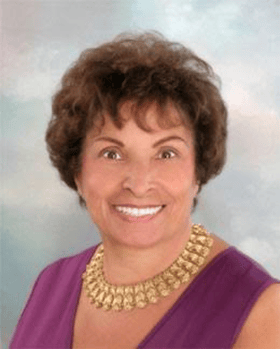
Naomi Wilzig was also known as a generous philanthropist true to her roots. She supported the Hadassah Hospital in Jerusalem, a rabbinical college and Chabad Lubavitch camp, and the US Holocaust Memorial Museum in Washington, D.C.
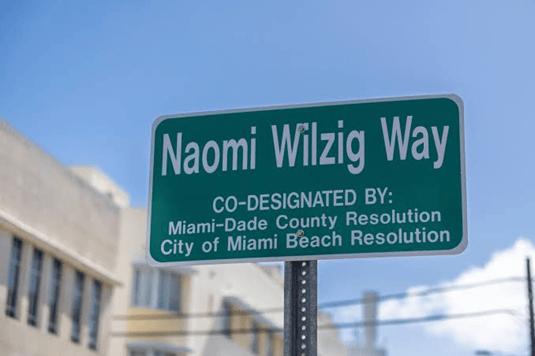
On April 20, 2026, a portion of 12th Street between Ocean Drive and Washington Avenue in Miami Beach, adjacent to the Museum, was officially dedicated and named Naomi Wilzig Way.
The Mural. There is not enough space to summarize the long life of Marjory Stoneman Douglas (1890-1998). She was a women’s suffrage advocate, a journalist, an author, and a conservationist. As a young woman, Douglas was active in women’s voting and civil rights movements. Douglas relocated to Miami from Minneapolis in 1915 when there were fewer than 5,000 people living here and started a long life as a journalist first with the Miami Herald, then as a freelance writer. She wrote extensively about the vast wetlands that covered the Florida peninsula west of Miami, the Everglades.
After five years of research, she wrote her still relevant tome, The Everglades: River of Grass, published 1947. With that, she took the role of “a relentless reporter and fearless crusader” for the natural preservation and restoration of South Florida. According to Douglas, “There are no other Everglades in the world.”
Her relentless efforts raised America’s consciousness and transformed the Florida Everglades from an area that was looked upon as a useless swamp – to be drained and developed commercially – to a national park that is seen as a valuable environmental resource to be protected and preserved.
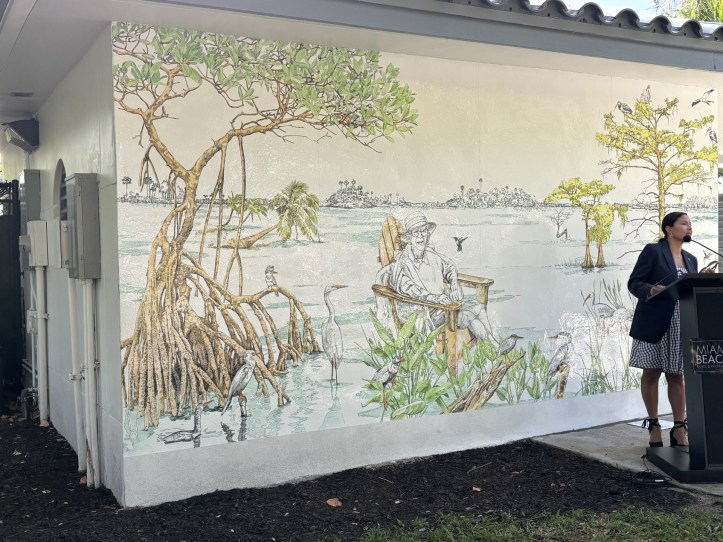
In March 2026, a mural honoring the “Grande Dame of the Everglades” was unveiled in Marjorie Stoneman Douglas Ocean Beach Park in South Beach. She Spoke for the Birds by artist Christina Pettersson recognizes this amazing woman and her conservation work for which Douglas received numerous awards, including the Presidential Medal of Freedom in 1993.
The Historic Marker. Josephine Baker (1906–1975) was an American dancer, singer, actress, and civil rights activist who found fame as an expatriate in Europe. A St. Louis native, she built a career from vaudeville performer to night club sensation. Baker was the first African American woman to star in a motion picture. She made her fame and lived her live in France because of American racial policies.
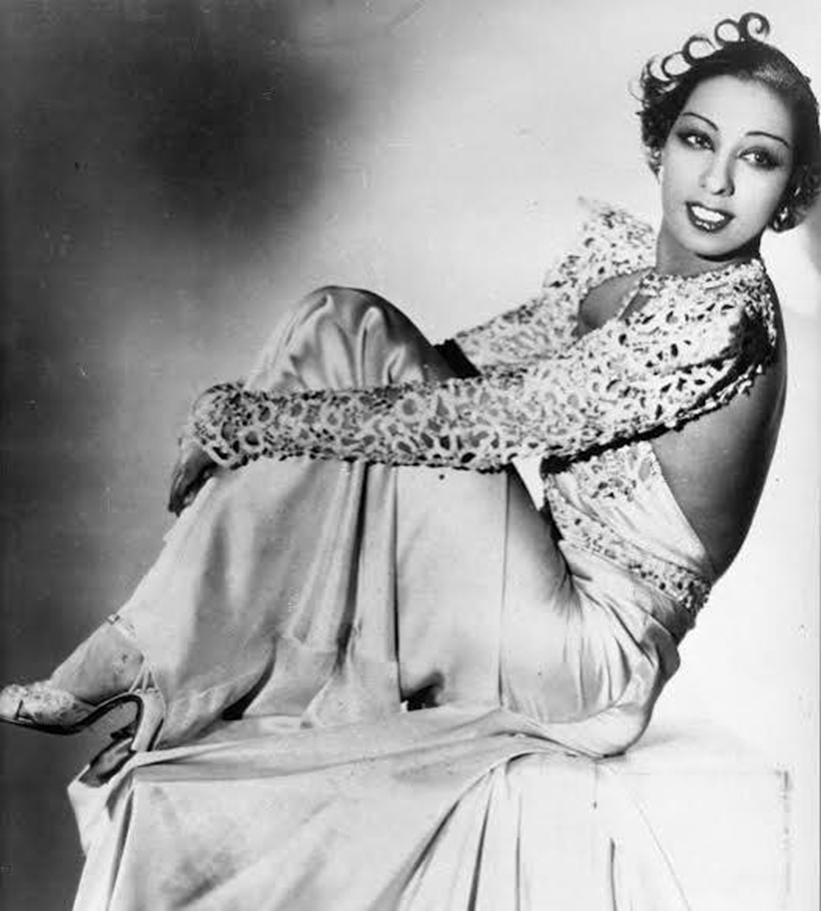
During World War II Baker performed in front of integrated French and American troops. More significantly, she was a member of French Resistance forces for which she received the Croix de Guerre. She later returned to the US to take part in the Civil Rights Movement, the only woman to take part in the March in Washington in 1968.
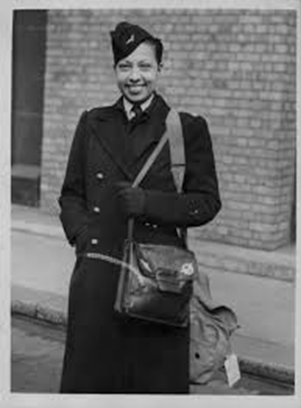
In 1950, Baker was offered a lucrative contract to perform at Miami Beach’s glitzy and popular Copa City Club. She refused, however, to perform for a whites-only audience and required that the promoters desegregate their club. She made sure the audience would be integrated by flying in black and white celebrities from New York for her opening. On January 10, 1951, the singer’s show in Miami Beach was a huge success. Baker drew national headlines and set a precedent for later tour stops.
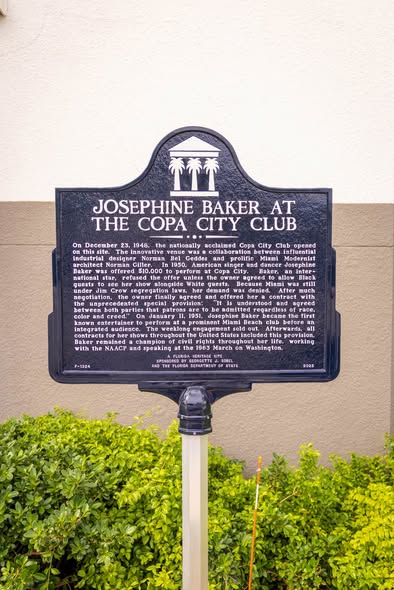
The City of Miami Beach and its Commission for Women moved to honor Baker in November 2026 with a Florida historical marker recognizing her stand against segregation.
Art Week Miami Beach 2026 officially starts sometime next week. No doubt Constant Companion and Daughter and I will fill the days ahead with numerous art outings. I wanted to take a moment before I started to introduce another side of Miami Beach.

