It seems that some of the components of our annual trifecta, birthdays in July, August, and September, are repeated. They are a nice meal and an art museum visit. The meal might be a return to a favorite restaurant or an adventure to new a place. It is often a home cooked meal carefully prepared for the birthday person. And the museum visit for the past few years has been a trek up to Palm Beach to enjoy whatever the featured exhibit at the Norton Museum. This past week we went a bit closer to home for Constant’s Companion’s celebration.
The NSU Art Museum of Fort Lauderdale was on our horizon. The exhibit of the work of Haitian artist Frantz Zéphirin (b. 1968, Port-au-Prince, Haiti) attracted both of us. He also wanted to see Close to Home, an exhibition featuring the work of South Florida artists many of whom we both know.
As to the home cooked meal, I returned to a favorite, Moroccan bstilla, with a twist, tossed salad and pavlova. This recipe lingered on my desktop waiting for the right occasion. Funny thing, I had already saved it in my Recipes folder
Moroccan Chicken and Spinach Filo Pie. Traditional bstilla does not include spinach. I found this to be quite an acceptable fusion with spanakopita minus the feta. Because it was a work day, I did my prep in stages through the day in order to break up the many steps.
In the morning, I sautéed about 10 ounces of fresh spinach with chopped garlic in a bit of olive oil. The recipe calls for a box of thawed, frozen spinach, well drained.
In the afternoon, I chopped up two poached chicken breasts* (making about 2 cups) that I had stashed in the freezer for a use like this. Next, I sautéed chopped onion also rescued from the freezer in the same skillet that I’d done the spinach in earlier. Add 2 minced garlic cloves and an approximation of 2 teaspoons of ras el hanout (I make a mixture omitting the cumin). When that is nicely done, toss in the chicken, make sure all the pieces are nicely integrated into the onion/spice. Add salt and pepper, 3 tablespoons of silan (date honey) and 3 teaspoons of lemon juice. Set aside.

*I took the chicken and onions out of the freezer to thaw in the morning so they’d be ready when I got home.
In a small skillet toast about two tablespoons of nuts. The recipe called for pine nuts. I used shelled pistachios that were waiting for a recipe like this. I’ve always used almonds in the past, the usual nut in the dish. Set aside to cool. Then put into a food processer with 2-3 tablespoons of powdered sugar and 12- tablespoons of cinnamon. Process til finely ground. Set aside.
Lightly beat three eggs, scramble, with a little salt and pepper, set aside.

Next start the assembly line. Spray or butter a pie tin. Layer with 8 sheets of filo, brush each sheet with oil/melted margarine/butter. Let the edges to hang over the sides of your pan.
And here’s where I went off track and did not follow the recipe. Rather than adding all the ingredients and covering, I layered them with several layers of filo brushed with oil in between. First all of the sugar/cinnamon nut mixture. Filo. Chicken mixture. Filo, Spinach. Filo. Scrambled eggs. Gently fold the filo hanging off the sides over the top, brush with oil. Add 3-4 more sheets of filo to fully cover. Brush the top with a beaten egg. Place in a preheated oven to 350°F. Bake 20-25 minutes or until top is golden. Allow pie to cool for 10-15 minutes before slicing. You can invert it onto your serving plate.

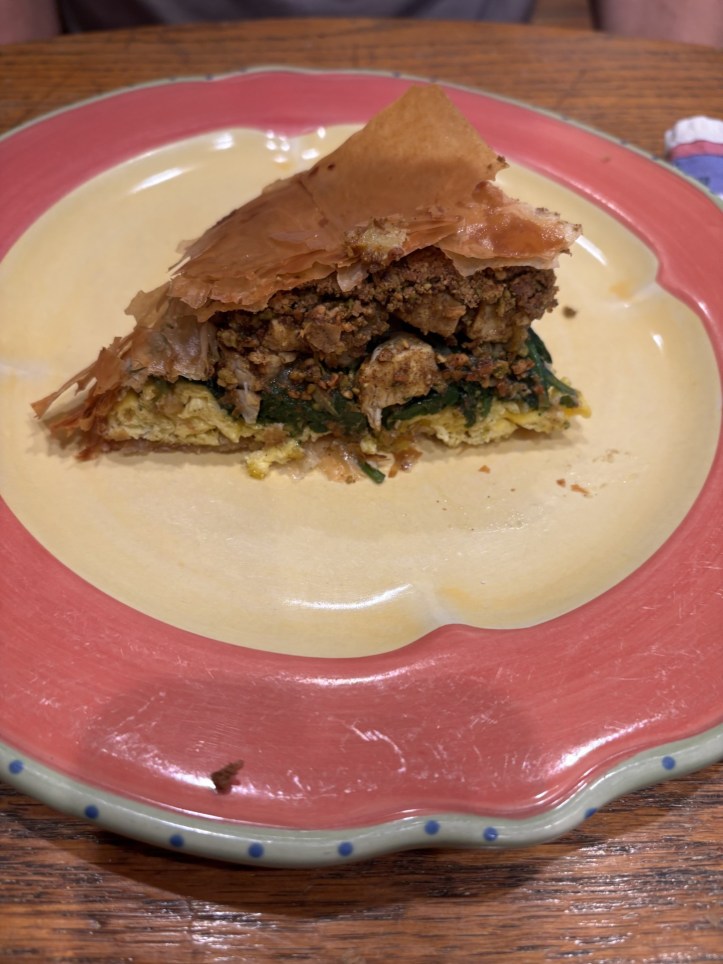
And you have 3 leftover egg whites, perfect for a dessert pavlova (see 4/10/23 post for a pavlova recipe). Actually, I made the pavlova first; while it was baking I was doing all this carefully calibrated prep for the birthday bstilla. Served with chopped mango, last of the season.

The next day, Constant Companion and I started off on the museum part of the annual celebration. We have so many connections to Haiti and Haitian art. In grad school, my assistantship was with CREDLI, the Haitian Creole Institute at Indiana University. Since living in Miami, we’ve made friends with a number of people who came from Haiti. So, our desire to see The Messenger. According to the wall text, Zéphirin was a self-taught artist. His uncle was uncle, Antoine Obin, celebrated master of the Cap-Haïtien school.

His early works are in the Northern Haitian tradition of narrative painting grounded in Haitian daily life.

Zéphirin has gone on to create his own miniaturist style of painting, replete with political history, Vodou spirituality, and intensely decorative renderings of people. His images visually bring to life stories of ancestral and contemporary struggle: depictions of Haitian slavery and emancipation, Vodou’s uniquely syncretic belief system, his country’s ecological collapse, and the on-going devastation at the hands of gang violence.

This piece, Fighting for Freedom, reminded me of the Indigo Room, also in the NSU Museum by internationally known Haitian-American artist Edouard Duval-Carrié.

Actually, we had a food adventure on the way home. Our search for lunch took us to a characteristic, ubiquitous strip mall and Fiesta Manila (1618 SE 10th Ave, Fort Lauderdale, FL). An experience with a new cuisine.

