This blog commenced some time ago with several goals in mind. From the onset of Covid, I sought an escape to keep my mind alive and active. It’s a platform on which I could write about creativity, my own and wherever I have found it and myself.
It’s also a venue on which to write about folk culture including food history, especially Jewish food history. There are entries through this blog about Jewish food and other traditional foodways.
Many foods are associated with the Jewish New Year, Rosh Hashanah. Within the realm of kosher and certain other traditions, there is lots of variation. Symbolism also abounds in these traditions (see 9-30-2019, 8-30-2021, 9-25-2026, and 10-3-2023 for previous posts about this holiday season, excuse me if I repeat any recipes or information).
Several everyday foods whose names come from Aramaic appear on many New Year tables. Filled with symbolic meanings, they are known as simanim or “signs.” In the past so many years, a new tradition called a Rosh Hashanah seder has been created and perpetuated. On the other hand, a series of blessings on the food of the season, “Yehi Ratzones or May it be Your will …,” far predates this new practice.
In the past few weeks a list of symbolic foods circulated in cyberspace. It included 10 symbolic foods, foods associated with the beginning of the agricultural year in ancient Israel.
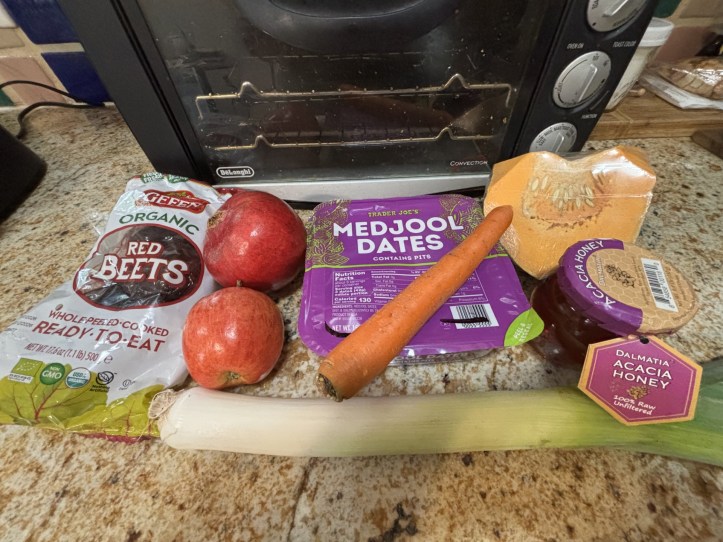
Dates (t’marim) “to be finished,” that hardship would end;
Pomegranate (rimon) filled with hundreds of seeds, represent a wish for our good deeds (mitzvot) and merits to be as plentiful as the seeds;
Black eyed peas (rubia) a fruitful year where our merits increase;
Leek (karti) sounds like “to cut off” may our spiritual enemies be cut down;
Beet (selek) “depart,” remove any enemies;
Squash or pumpkin (ka’ra) harsh decrees “be torn away” and misfortune be removed;
Carrot (gezer) to increase, have an abundant New Year;
Apple (tapuach) the gemetria (number association) of apple equals akeda, the Torah portion read at Rosh Hashanah;
Honey “May it be Thy will to renew unto us good and sweet year”;
Fish head (rosh or head) “We should be the head and not the tail,” we should lead the upcoming year with strength and integrity
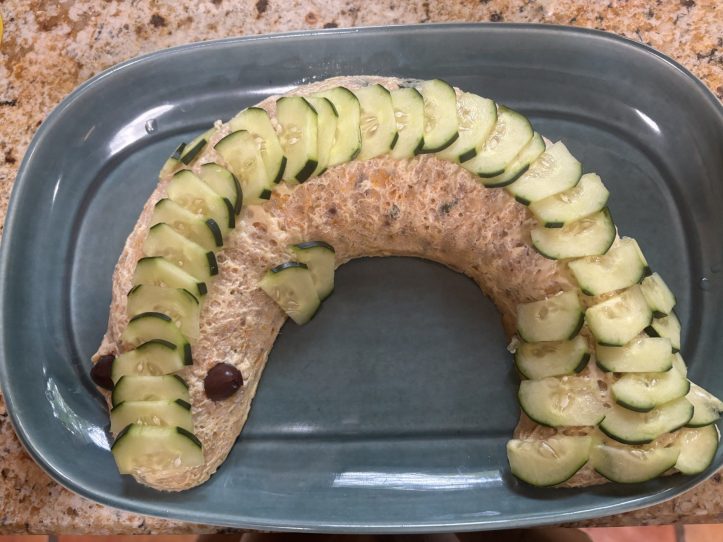
Daughter told me that my menu went overboard this year. It incorporated a number of these simanim in our Rosh Hashanah dinner. Pumpkin was roasted with beets, carrots were in the soup and rice, we dipped apples in honey and in the cake. Pomegranate was one of the many jewels in jeweled rice. And, I used my mother’s old fish jello mold for the gefilte fish.
As usual, I cooked over 2 days. Thursday was the soup, the apple cake, and the gefilte fish on. Then Friday I prepared the shallot tarte tatin, pumpkin with beets, the rice (see 9-18-2023 for the recipe), and roast chicken. I also made the matza balls for the soup. Yes, I overdid, but we so enjoyed it all!
Gefilte fish. I tried a new recipe and everyone voted it to the “Keepers” list. Start with on pound of salmon fillet sand ½ pound of whitefish (I chose swai fillets at the market), skin removed from both. Pulse in the food processor until finely ground. Saute one small onion diced onion and 1 grated carrot in oil over medium heat, about 8-10 minutes. In a stand mixer mix the fish, 2 large eggs, ½ cup water, 2 tablespoons matzo meal, some kosher salt and pepper, 1 tablespoon sugar, 1 tablespoon fresh lemon juice, the onion/carrot mixture, ¼ cup fresh parsley or dill, and 1 teaspoon Dijon mustard. Next time I’ll include dill.
The recipe recommended using a ring mold; I used the old fish mold. Pour the batter into a well, greased mold, smooth the top. Place into a bain marie (warm water in a slightly bigger pan). Cover with foil. Cook for 1 hour in a 350 F oven. Cool for about 20 minutes, then carefully unmold. Cover and refrigerate until serving.
Shallot TarteTatin. This recipe was a challenge for my and my patience. There are numerous steps that need full attention; done step by step the result is worth the efforts.
Preheat oven to 400°F. Peel and cut about 1 pound of shallots in half lengthwise, keeping a bit of root intact to hold together; set aside. Melt 2 tablespoons butter (I used olive oil) in a 10-inch ovenproof stainless steel skillet; remove skillet from heat. Tightly arrange shallots, cut sides down, in skillet. (Skillet should be fully covered; better to be overcrowded than under.) Return skillet to heat over medium; sprinkle shallots with salt. Cover skillet using a tight-fitting lid; cook, undisturbed, until shallots begin to soften and become translucent, about 5 minutes. Uncover and cook, undisturbed, until cut sides are a rich golden brown, 2 to 3 minutes, rotating skillet as needed to encourage even browning. Add 2 tablespoons vinegar and 4 teaspoons water to skillet; cook over medium, undisturbed, until liquid is almost fully absorbed, about 3 minutes. Carefully transfer shallots to a plate using a spatula to keep shallots tightly together, and set aside. Clean and dry skillet.
Return skillet to heat over medium. Here’s the step that needs patience. Add 2/3 cup granulated sugar in an even layer; cook, swirling skillet occasionally, until sugar is melted and amber-colored. The recipe said about 8 minutes. It took more like 15 minutes. Remove skillet from heat; add remaining 1 tablespoon butter,* stirring constantly, until well combined. Quickly and carefully, tightly arrange shallots, cut sides down, over caramel in skillet. Cover with puff pastry sheet, tucking excess corners under pastry; bake in a 400 F oven until puffed and golden, about 20 minutes.
*I frequently substitute olive oil for the butter. Constant Companion does not eat most dairy. A quick online survey highly recommended not substituting and I did not.
Whisk together 1 egg and 1 tablespoon water in a small bowl; brush pastry with egg wash. Continue baking until deeply golden, about 5 minutes.
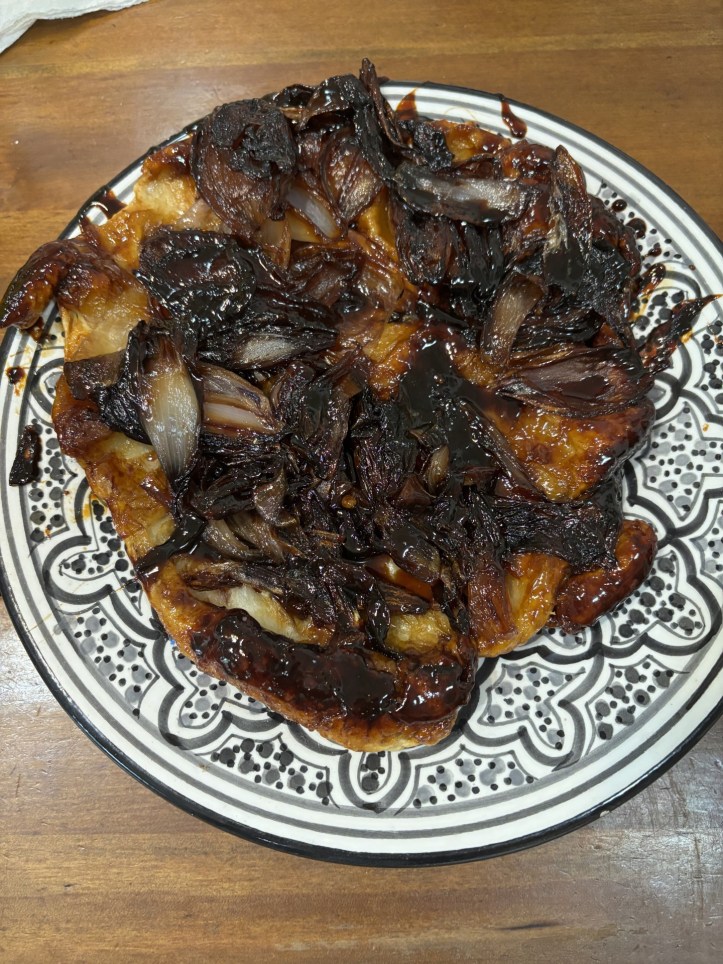
Immediately invert Tatin onto a large plate while hot. Let cool for 15 minutes before serving. Garnish with flaky sea salt and herbs; serve with crème fraîche, if using.
Tarta de Santiago or St. James cake. For dessert, I chose this rich almond cake with chopped apples. The origins of this cake from Galicia date to the Middle Ages and the Camino de Santiago. The ingredients mainly consist of ground almonds (almond flour), eggs, and sugar, with additional flavouring of lemon zest, sweet wine, or brandy, depending on the recipe used.
Food writer and historian Claudia Roden traces the origins of the cake to the 11th century, as Jews fleeing the Almohad Caliphate headed north, bringing their almond Passover cake. The first documentary evidence of the cake’s existence date to 1577, when it was mentioned in notes of what was being eaten at the University of Santiago de Compostela. In May 2010, the EU gave Tarta de Santiago PGI status, or Protected Geographical Indication, in Europe.
Place a rack in middle of oven; preheat to 375°. Lightly coat a 9″-diameter cake pan with nonstick vegetable oil spray; line bottom with a parchment paper round. Using an electric mixer on medium-high speed, beat 5 large eggs and 1¼ cups (250 g) granulated sugar in a large bowl until aerated and very pale yellow, about 5 minutes. Reduce mixer speed to medium-low and beat in 1 Tbsp. finely grated lemon zest, 1 Tbsp. finely grated orange zest, and 2 tsp. Diamond Crystal or 1¼ tsp. Morton kosher salt. Add 2½ cups (250 g) almond flour or meal and beat just to combine. Using a rubber spatula, fold in 1–2 peeled apples (about 2 cups), cored, cut into ¼” pieces. Scrape batter into prepared pan; smooth surface.
Bake tarta until golden brown and it springs back when gently pressed, 35–40 minutes. Transfer pan to a wire rack; let tarta cool in pan 10 minutes. Run an offset spatula or small knife around sides of pan to loosen cake. Turn out onto rack, carefully turn right side up, and let cool completely.
Just before serving, transfer tarta to a large plate and dust with powdered sugar.
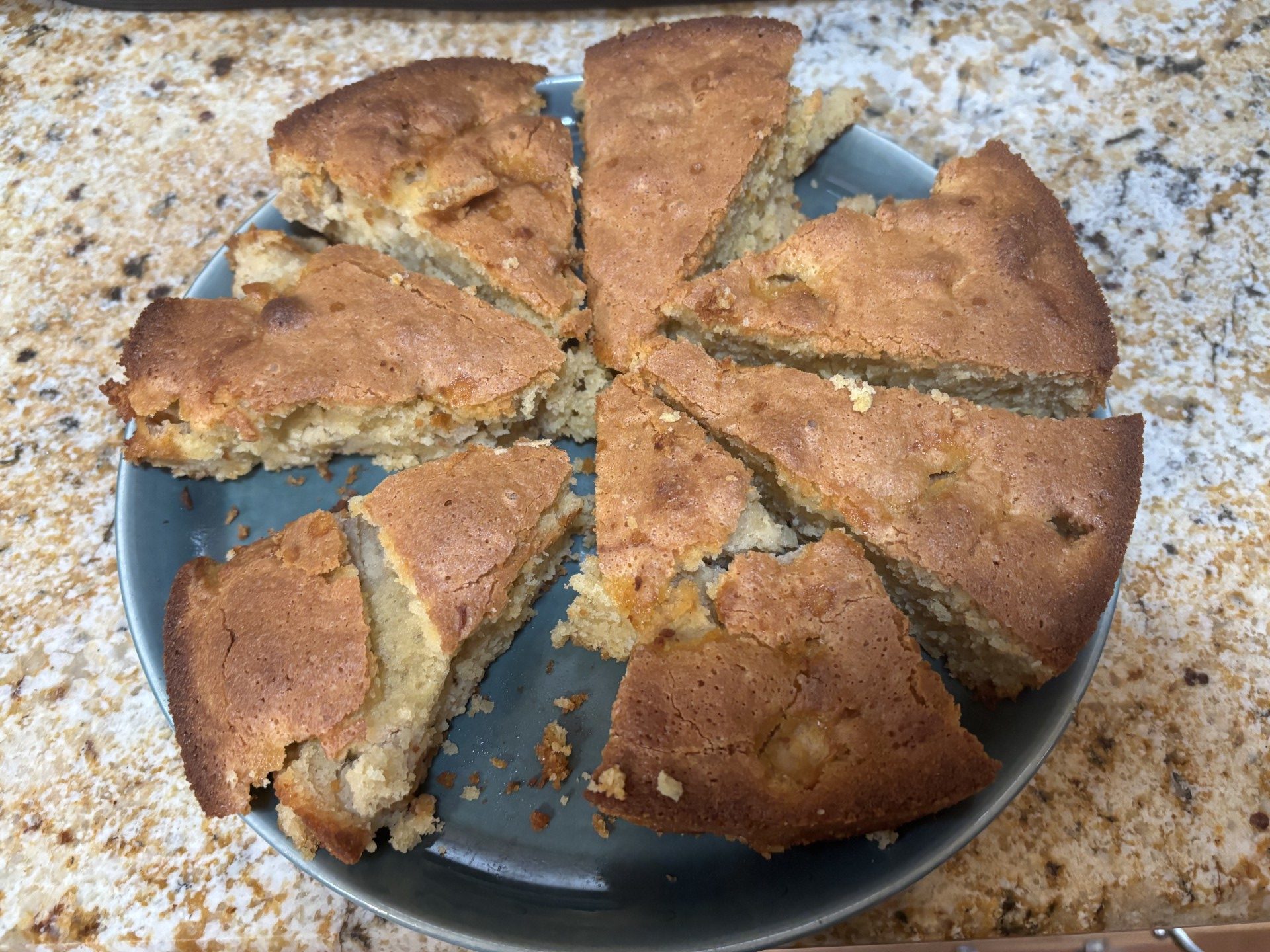
Do Ahead: Tarta can be baked 1 day ahead. Store tightly wrapped at room temperature (or chill if you prefer a softer texture).
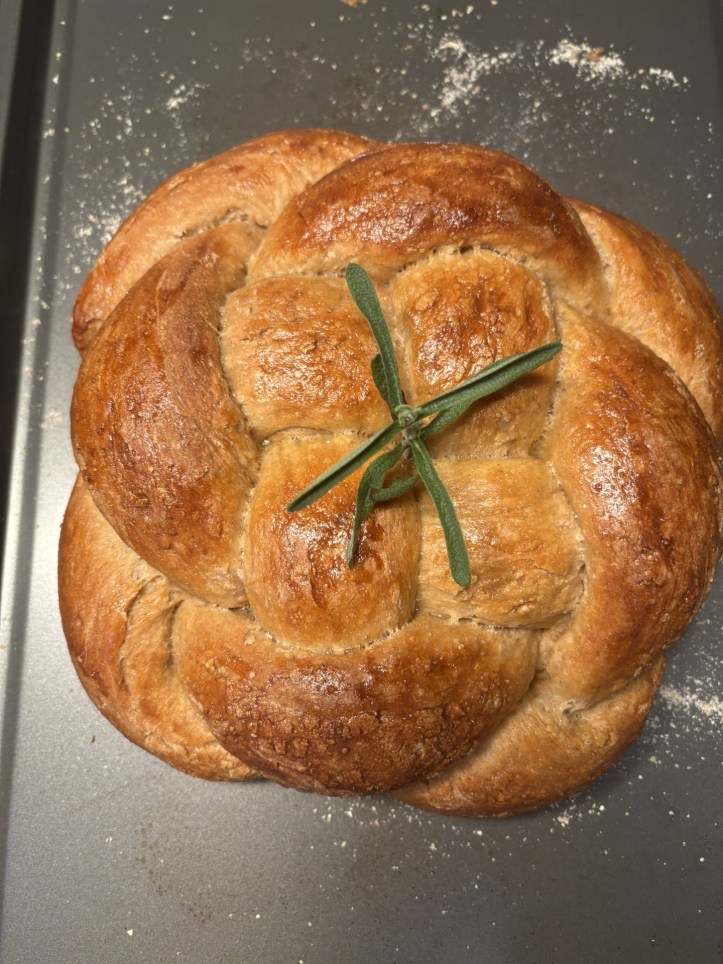
Daughter contributed to our Rosh Hashanah meal. She baked a beautifully braided challah, round to symbolize the cyclical nature of our lives.
Cooking year round is one of my creative and joyous (though sometimes difficult) outlets. Holidays often offer more meaningful foods. Constant Companion and Daughter and guests profit from my efforts.


Loved all the photos. Happy New Year!
LikeLike
Shana Tovah to all of you!
LikeLike