Another Year, Another Trifecta. July brings the birthday season: me in July, Constant Companion in August, and Daughter in September. I gave some thought to the question of what did I want for my birthday. No jewelry, no dinner (we go out anyway). What then?
A few years ago, after an incredibly lovely, lively wedding weekend in Fort Pierce, Florida, Constant Companion and I drove home through Stuart, Florida. It was cute and warranted a return visit. In honor of my annually increasing age, off we went for two days in Stuart to mark the day. The beaches are beautiful, more waves than at our Miami Beach beaches. The restaurants are mainly sandwiches, salads, and “catch of the day.” The shops are cute, however, as one of my brother’s says, “spendy.” What did we do? Our usual default – museums. Stuart is home to two museums: The House of Refuge at Gilbert’s Bar and The Stuart Heritage Museum.
When we reached our destination, the beaches were our first stop so we could choose which one to enjoy on the next day’s early morning. Along the way, we stopped at the House of Refuge.
The House of Refuge, also known as Gilbert’s Bar House of Refuge is the oldest structure in Martin County. It remains a document to 19th century history of our country when commercial sailing ships carrying cargo along the Atlantic coastline were wrecked by our wild weather. Ten Houses of Refuge were built along Florida’s coast in 1876 by the US Treasury Department and run by the US Lifesaving Service. The keepers of these outposts provided havens for sailors and shipwreck victims. It is the only remaining one.
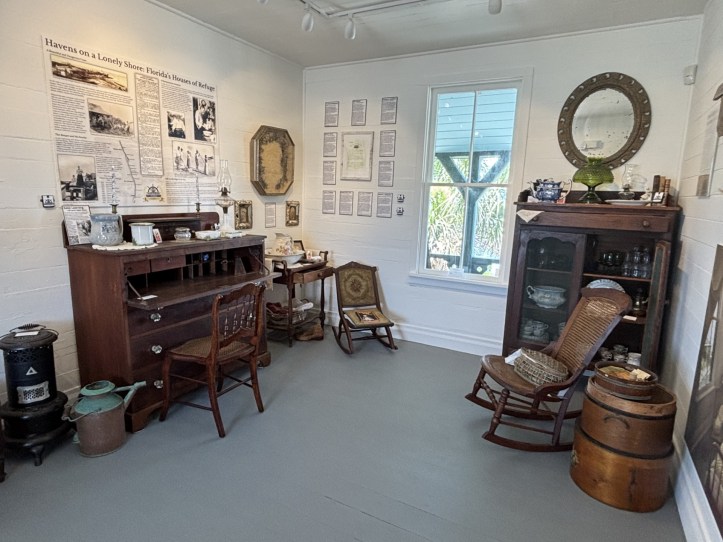
When the Service morphed into the US Coast Guard in 1915, Gilbert’s Bar House of Refuge became a Coast Guard Station. It remained active during World War II when it was a lookout for for German U-boats after freighters were torpedoed off the Treasure Coast in 1942.
The House of Refuge was built on the coastal rocks know as the Anastasia Formation or “St. Lucie Rocks” or Gilbert’s Bar. It is one of the most prominent geologic outcroppings along the entire Eastern seaboard.
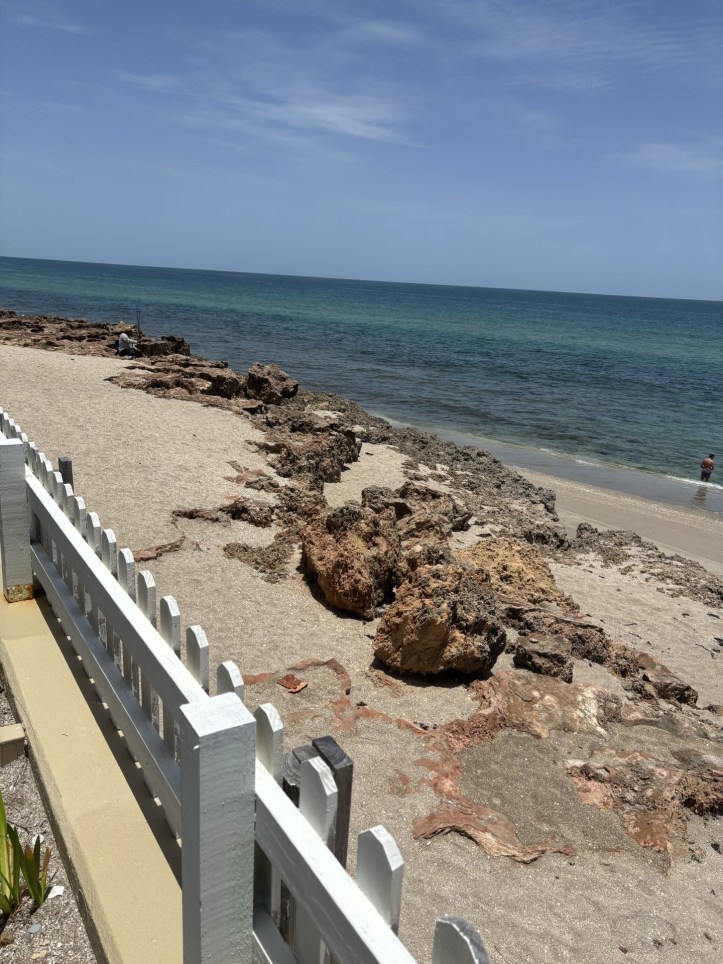
Today, it is owned by the Martin County government and operated by the Martin County Historical Society. It is filled with several stories about the building’s history, the role it played, the life of the many keepers c. 1904, and the environment in which it’s located. The House of Refuge is listed on the U.S. National Register of Historic Places.
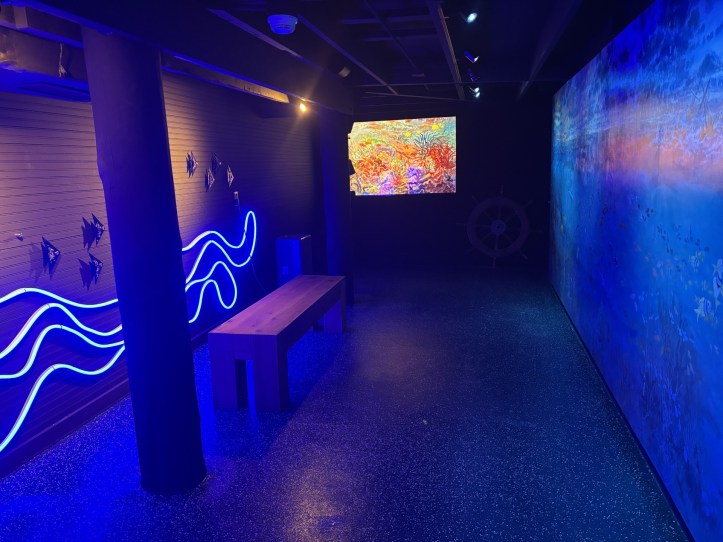
Our guide encouraged us not to miss The Tempist: Experience the Storm, an installation in the lower level of the House; it was an immersive experience that took visitors into the area’s forces of nature. I was not keen on an “immersive experience” but decided to go. It is amazing! A long room is filled with the sights and sounds of the waves, thunder, wind and more. A 50’ mural by Ralph Papa, a native New Yorker who now paints in Southeast Florida (https://ralph-papa.pixels.com/), fills one wall. An undulating strip of neon populated with hand blown fish fills the opposite wall. At the far end of the room, animated cells of the mural leap to life. This is really great experience not to be missed.
The Stuart Heritage Museum is housed in the former George Parks Store, the oldest commercial building in Martin County, built in 1901 to house the George W. Parks General Merchandise Store. For many years, it was home to the Stuart Feed Store. This history is reflected on the exterior of the building.
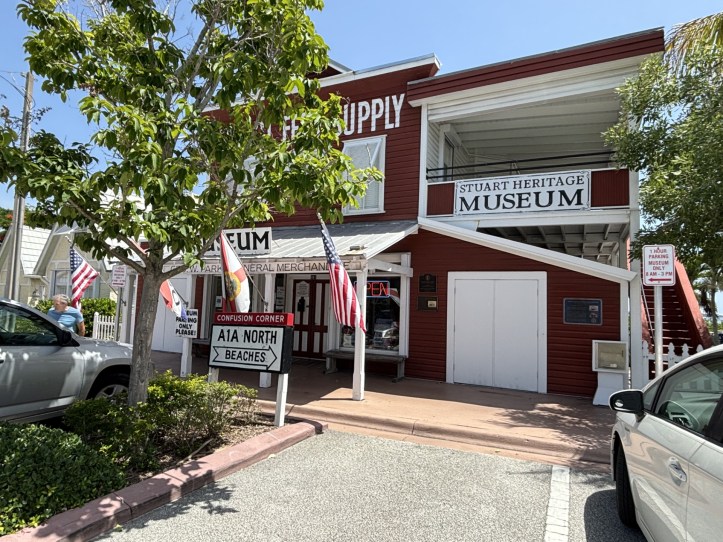
The vernacular commercial building was restored by the city to be a museum and opened in 1992.
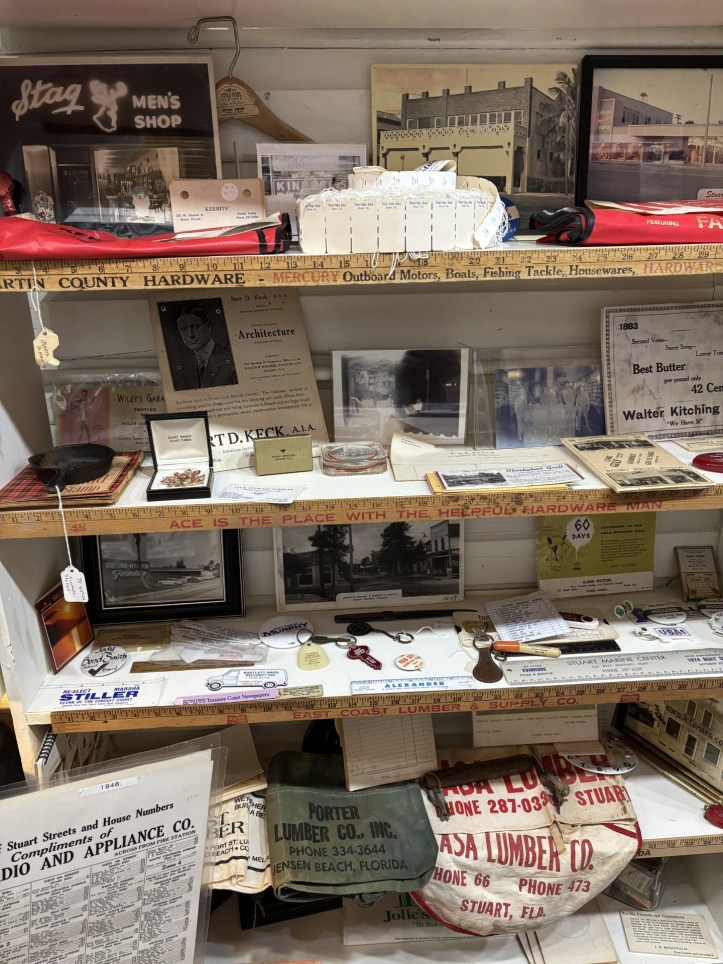
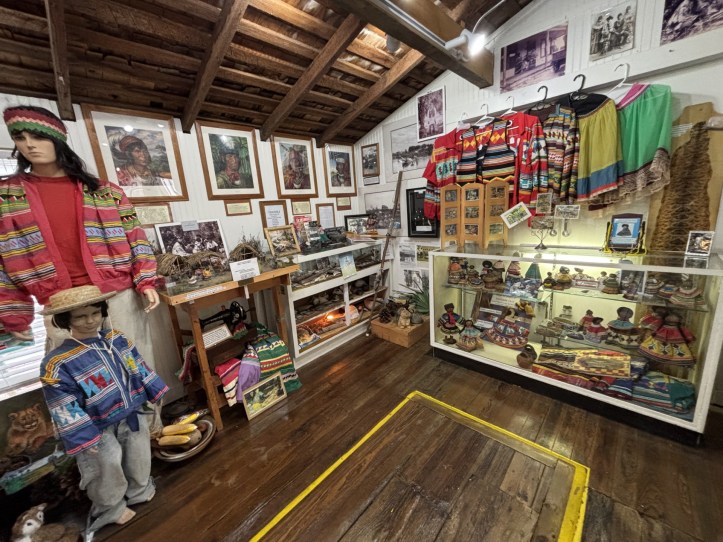
It is a treasure house filled with the remains of the city, not to be missed. Squeezed into every conceivable space of the museum are over 10,000 objects from the 1880s to the 1950s: pictures of the railroad, materials from the Seminole people, and an ice cream parlor just scratch the surface of all that we took in during our visit. One visitor characterized the museum as “quaint.”
While in Stuart, we saw only two of the many sculptures found around town.
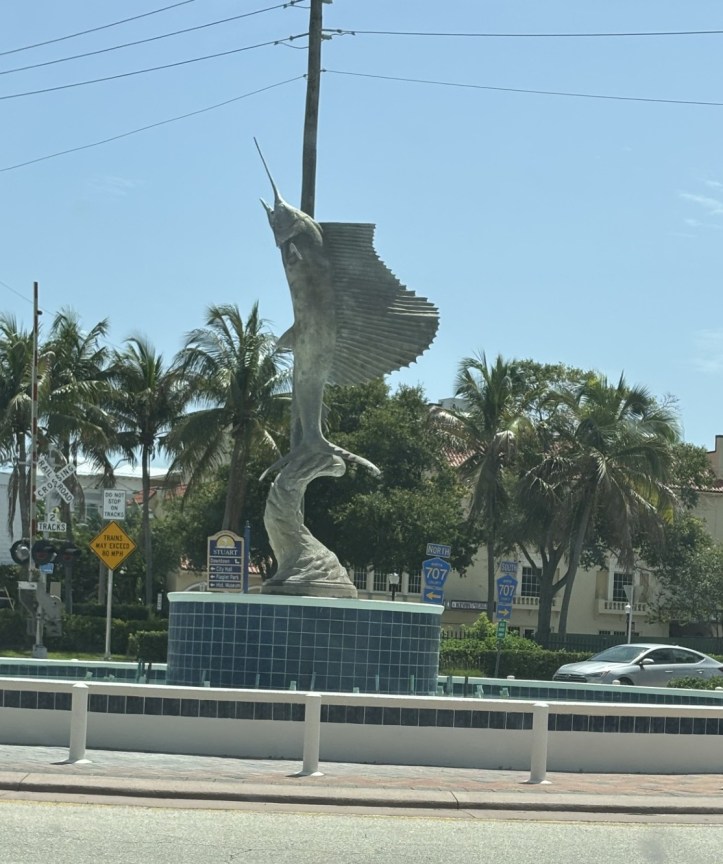
Stuart, Florida has been recognized as at least three “capitals of the world.” First is the “Sailfish Capital of the World.” This achievement is marked in several ways. The Sailfish Sculpture, an 18’ tall bronze statue by local artist Geoffrey Smith (https://www.geoffreycsmith.com/) is found in the center of the fountain in Sailfish Circle. Five Sailfish Historic Markers are distributed around town, we only saw the one marking the site of the Train Depot Station where the historic Florida East Coast Railway brought countless winter visitors from 1913 until the 1960s
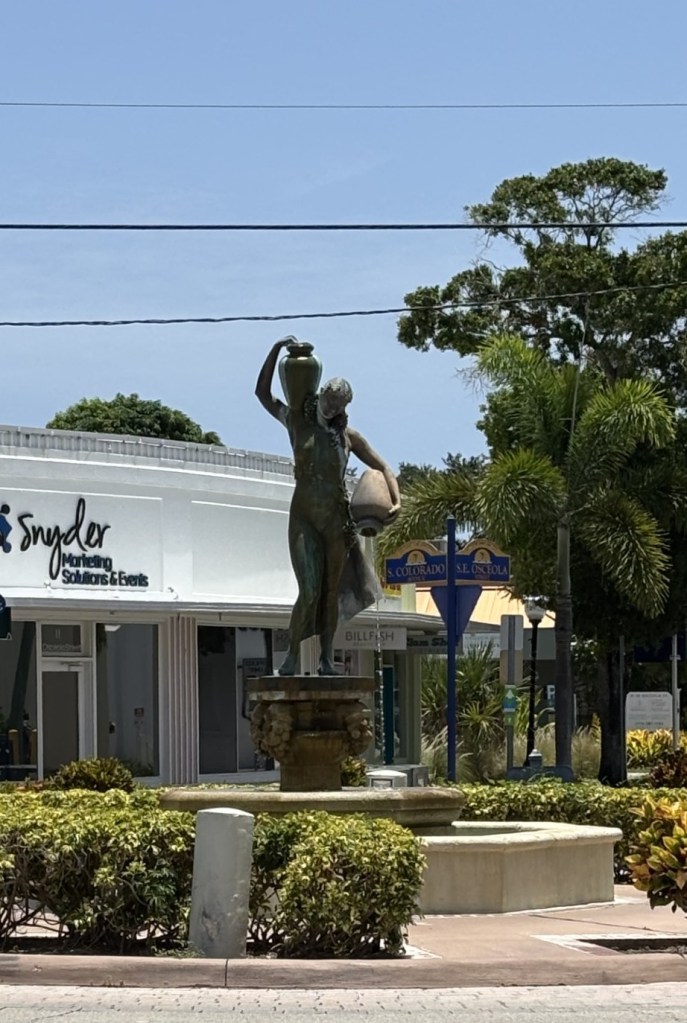
Lady Abundance has graced another Stuart plaza since 1949. She was supposed to be part of the French pavilion at the 1939 New York World’s Fair, but never appeared because of World War II.
Among the many historic buildings are the Post Office Arcade and the Coventry Hotel and Coventry Apartments (Old Colorado Hotel). The Arcade was built in 1925. The Old Colorado Hotel was built in 1914. It and several neighboring buildings have been beautifully restored by the current owners.

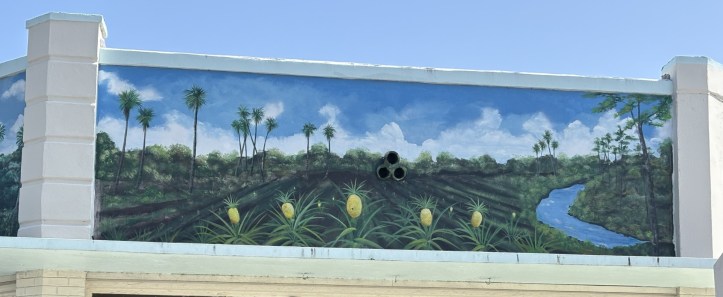
In the late 19th and early 20th centuries, the Stuart and Jensen Beach areas along the Indian River were known as the “Pineapple Capital of the World,” shipping hundreds of thousands of crates. The industry faded in the early 20th century. Stuart also was recognized as the “Chrysanthemum Capital of the World” during the 1950s and 1960s. I learned both these facts in the History Museum! I only saw a mural documenting the pineapples and that was in nearby Jensen Beach.
I thought I’d seen all there was to see in Stuart til I reviewed their Art & History Map. Maybe we’ll take another trek see more, even with no special occasion.


love following you on your adventures!
LikeLike
Great trip!
LikeLike