I’m trying to remember the excitement and wonder of what awaited me almost a year ago as I prepared to go to India on August 1, 2024, to teach a month-long, intensive museum studies seminar at the University of Rajasthan in Jaipur. There, I was to introduce graduate students studying archeology and museum studies to the processes of documentation of an orphaned collection of archeological materials and to guide them through exhibition curation using the same materials.
Fivedays a week (really four because there was a festival day every week) for the four weeks, my students bravely and warmly embraced me and my American approach to teaching. After introductions of museum basics, part of my foreign approach was to put decision-making into their hands and to build upon their knowledge.
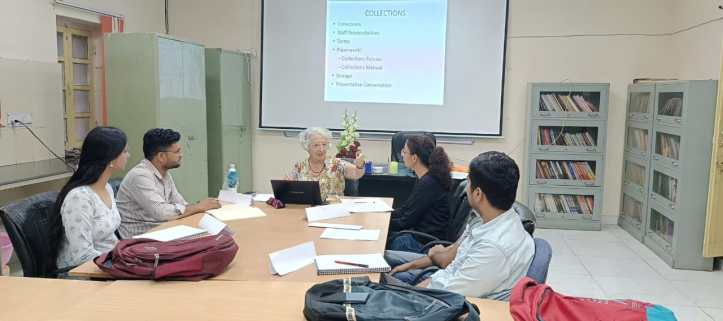
Task #1, Documentation. The students were introduced to one of the standard methods used to create records of museum collections. This involves a three-part number where the first number signifies the year the item(s) enters the museum collection. The second number identifies the group of items. Finally, the third number assigns a distinct number to each objects in each group.
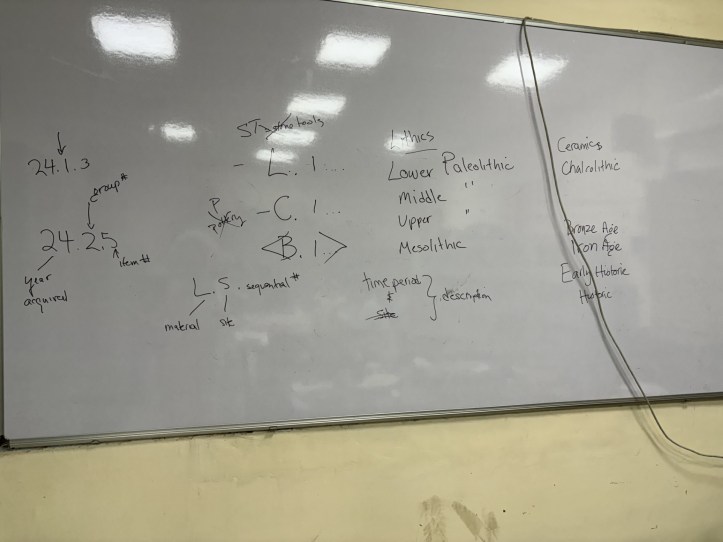
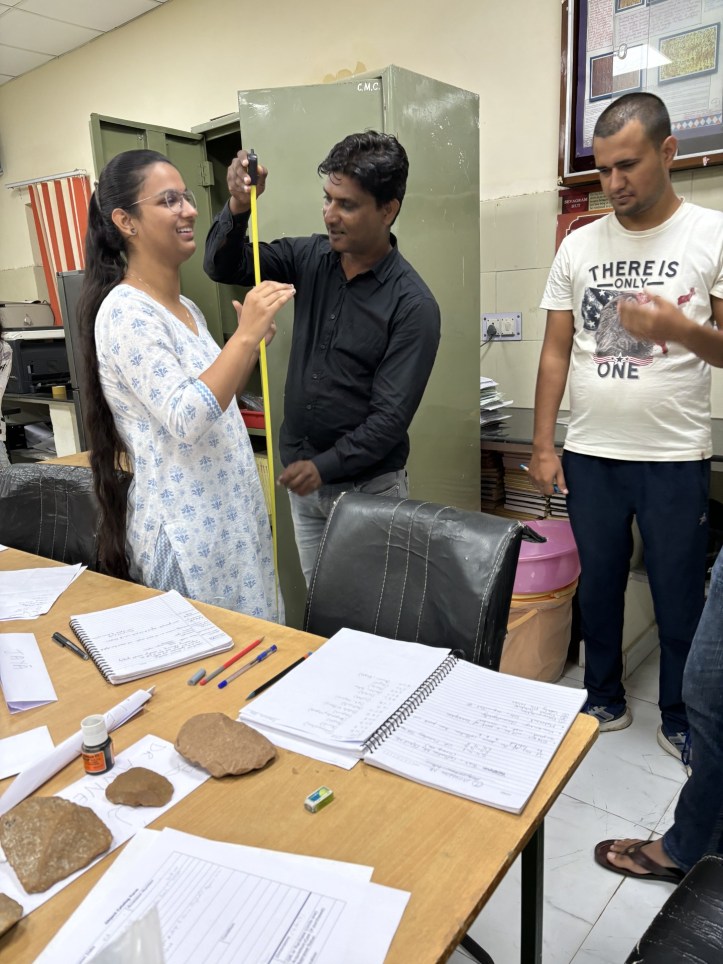
My students built a similar tripartite skeleton to establish a method that could be appropriate for this archeology collection and replicable. Their three-part number consisted of: 1-material (Lithic, Ceramic); 2 – site; 3 – sequential number. Then they set about measuring, putting numbers on the items, and creating catalog records.

Well, it was not all hard work!
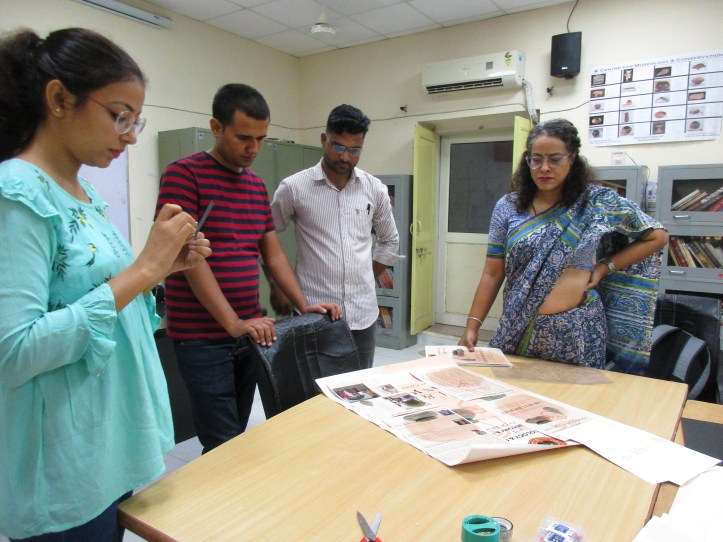
Task #2, Exhibition Development. The many steps in the process of creating an exhibition were introduced later in the month, again after some introductory material, I put the rest into their hands.* My approach is that communication is central to this process, a story of some sort should drive development of an interpretive exhibition.
*Well, there was the day when well-meaning professor Tamegh came into the lab and did his best to insert his ideas along with more objects to a well-crafted display. The students listened to his recommendation, then put into practice two precepts I’d discussed: do the objects support your story? Is there too much? Then they removed all that he added!
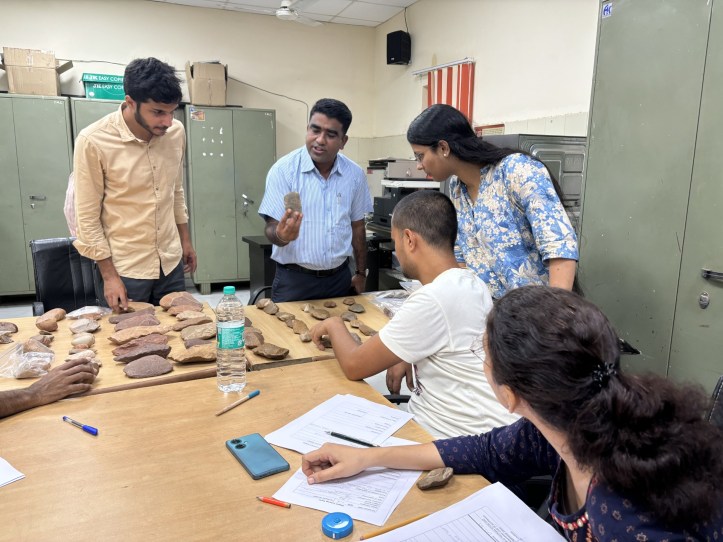
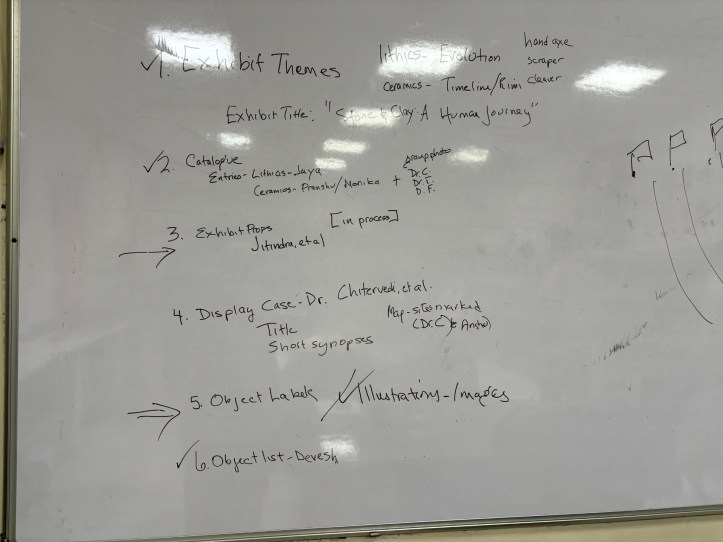
The group started by brainstorming their main message or messages and how to visually accomplish this with the limited resources on-hand. They came up with lots of ideas including the exhibit title – Stone & Clay: A Human Journey. They also broke into loose teams, different individuals taking on different tasks.
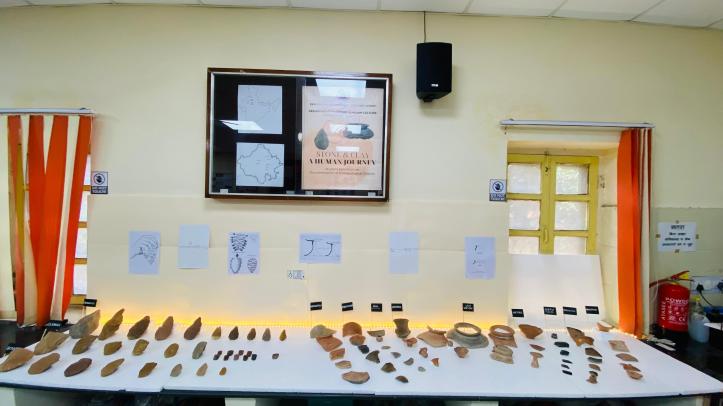
Side-bar. Before taking off for India, I asked what display cases would the students be working with. Somewhere along the way, I learned that a number of wall-mounted vitrines were filled with sculptural pieces. In the end, a long counter in the archeology lab was commandeered for the student exhibition.
The final exhibit decision was to work with, what else, lithics and ceramics. Three types of stone objects (hand axes, scrapers, and cleavers) were displayed chronologically to show advances in technology.

Ceramic rims were displayed chronologically to illustrate the artistry and aesthetics over time. In this section, the students built their display around a focal point, several larger pieces.

Visual images including a map of the sites and timeline were additional components of the exhibit to improve the communication.
The Department Chair, Dr. Neekee Chaturvedi, chipped by designing a poster and catalog for the student exhibition.
In between, my students and I made a few museum visits, looking at the exhibitions, what their goals were, and visitor behavior. Week one found us down the street from the school at the Albert Hall Museum (see 8/9/2024 post). Another day, we trekked across campus to the univesity “Geology Museum;” time limitations did not allow a visit to the “Zoology Museum” somewhere on campus
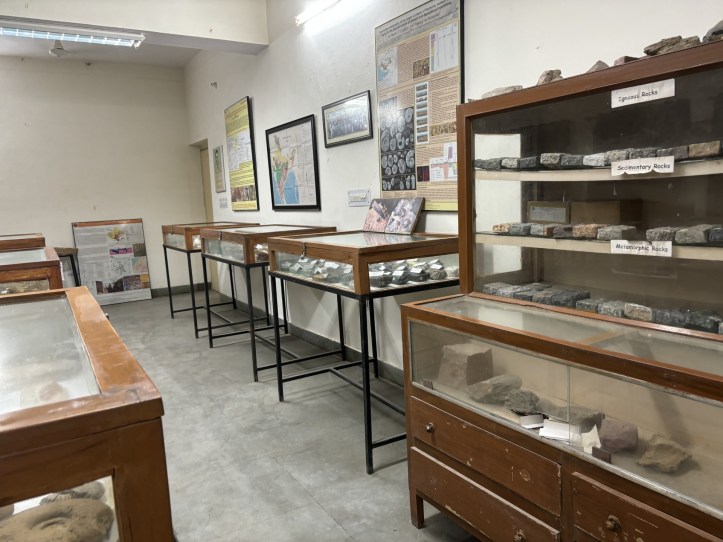
It was here that I realized that without display cases, our exhibit on the archeology lab counter would be an educational exhibition. The students took great pride in showing the exhibit to others.

This exhibit was truely a group effort, from working with the archeological materials and creating the system of documentation to developing a theme, curating, and installing an excellent exhibition that can be used for educational purposes.
Last year, while still in India and after I got home and the many experiences were still fresh in my mind, I wrote the following posts about my them and various observations: 8-6-24 (The Adventure Begins), 8-9-24 (Museums and Festivals), 8-14-24 (Of Forts and Fine Art), 9/21/2024 (Cavalcade of Color), 10/7/2024 (How People Get Around), 10/12/2024 (Folkore Radar), 10/21/2024 (Food in India-1), 11/5/2024 (Food in India-2), and 11/14/2024 (Stepwells). Take a look at them if you’d like to see more of what I saw.
 Creatively Annette