Last September, on my way home from my month in India, I had a brief stop in Ioannina, Greece, to speak at the Inaugural Global Women and Hellenism Conference sponsored by the Food For Thought Network (https://www.hcwa.org/en/1121-inaugural-global-women-and-hellenism-conference). What a wonderful, stimulating gathering of primarily Greek-Australian women with a few Greeks and Americans thrown into the mix. My contribution addressed the Hellenic nature of the Jewish women of Ioannina. It was an opportunity for another return trip to Ioannina.
After the conference papers, two excursion days had been organized. On day one, we ventured into Zagorochoria, the villages in the Pindus mountains north of Ioannina. The second outing took us west through Dodoni, an ancient archeology site, to Parga overlooking the Adriatic Sea. When I lived in Ioannina, many years ago, I spent a relaxing weekend with a friend at the beaches of Parga. I never went through the veil of mountains to explore the villages and physical beauty. This was a real treat for me.
Our motorcoach wended its way along Lake Pamvotis, the famous lake of Ioannina, through Perama, the town of the caves, before turning north to ascend the narrow mountain roads.

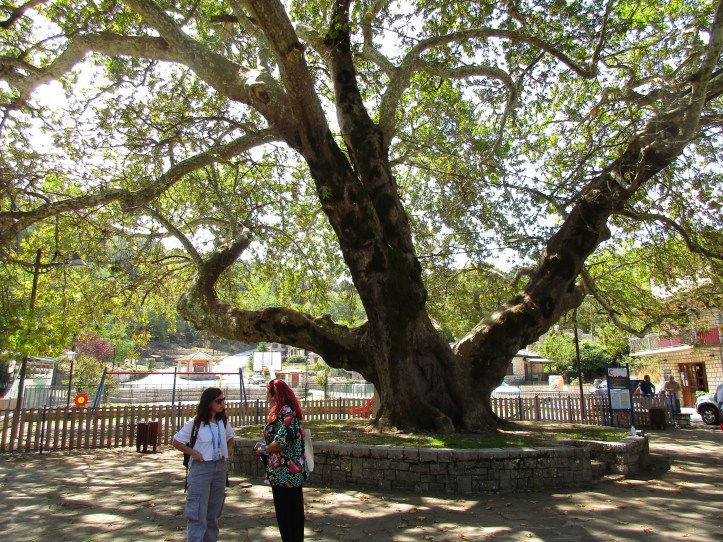
As we approached our first village stop, our guide informed us that each Greek village square (plateia) has three key elements: the central plane tree, the well, and the church. This village’s tree spread magnificently over the plaza.
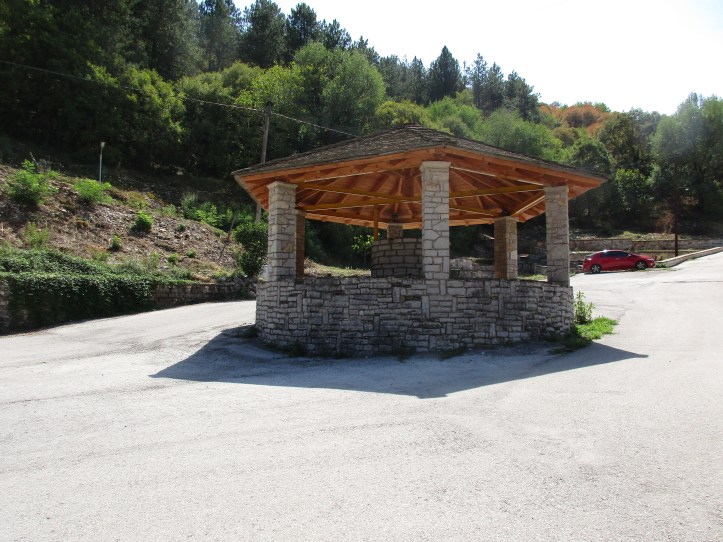
The well seemed to be only symbolic, no longer needed as most homes had running water.
The church, however, was nowhere to be seen at the center.
We were warmly greeted by the provincial governor and others at the square and treated to local specialities including alevropita or zumeropita.

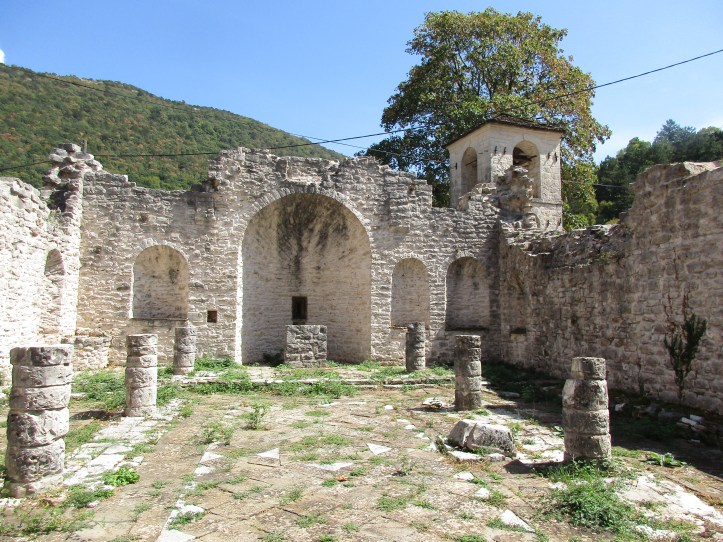
Curiosity took hold and I wandered off to find only ruins of what must have been a small, Byzantine-style church.

When I returned to the town square, the governor informed me that this village, like many others in the region, suffered during the German occupation of WWII. Among the properties destroyed was their beloved church. The village had decided to keep the ruins intact as a reminder of this history.
Next our group traveled higher and deeper in the mountains to Monodendri; for a lunch break and to see the Vikos Gorge. The rocky environment reminded me of the saying that the main product of this region, Epirus, was rocks!
Monodendri is a village of narrow, stone-paved walkways; yes, picturesque.

It has benefitted largely from philanthropy of two brothers from the village who achieved great success in commercial enterprises in Russia, Manthos and Georgios Rizaris. They offered substantial financial aid to the Greek War of Independence and also used their vast wealth to create a large charitable foundation.
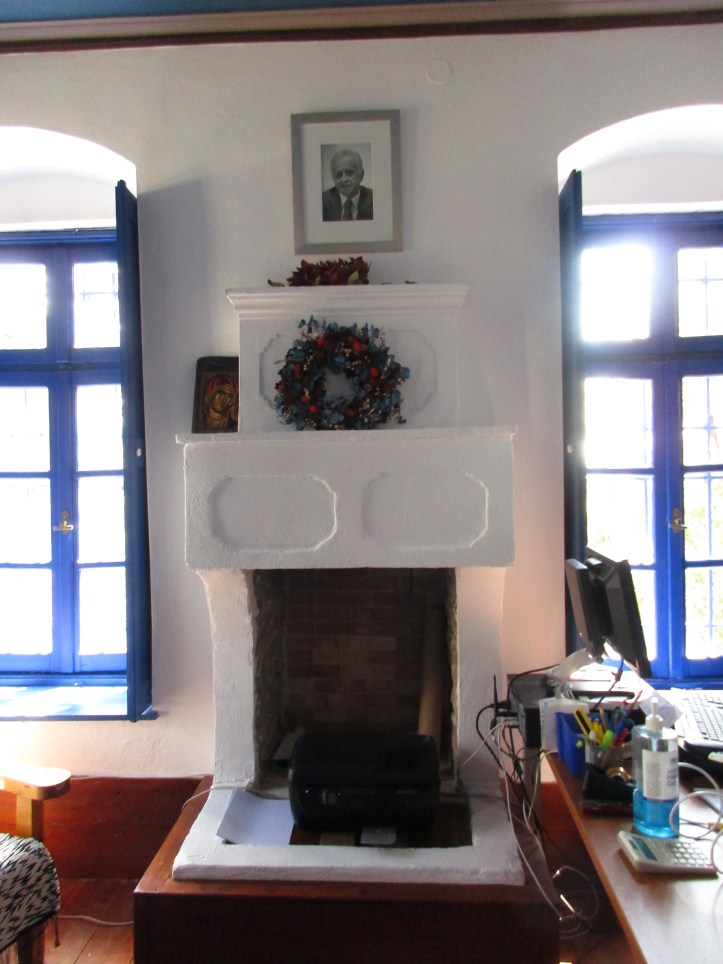
As my companions made their way to the square (plateia) for lunch, I was drawn to the local museum, Rizarios Exhibition Center for an exhibition of American photographer Robert A. McCabe.* His photos beautifully captured the resilience of the Greek people in the difficult years following WWII. The Museum is housed in the Pantazis mansion; I love the enigmatic architectural features characteristic of the mansions of the region, the fireplaces and wooden ceilings (https://www.greeka.com/epirus/zagorochoria/sightseeing/rizarios-centre/).

*When I returned to Athens from Ioannina, I visited the Acropolis Museum to find another exhibition of McCabe’s amazing photos. The one in Monodendri was better.
Next I stopped at the Rizarios Handicraft School, founded in 1979, where local weavings and embroideries were on display and for sale in another former mansion.
Adjacent to the plaza was the tiny 17th century church of Agios (Saint) Minas filled with beautiful murals that were painted between 1619 and 1734.
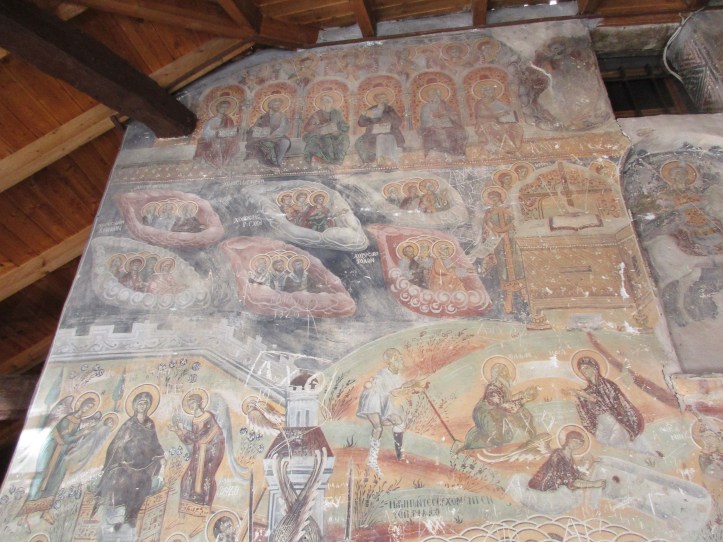
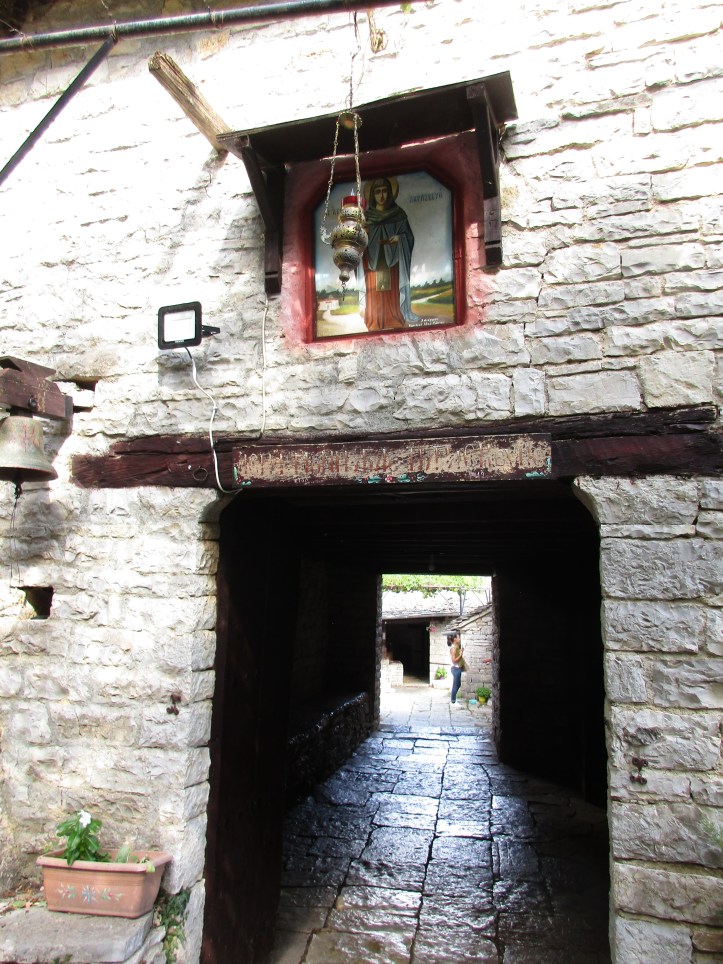
After lunch, I joined several lovely Greek-Australian colleagues and descended the stone-paved pathway to the Monastery of Agia Paraskevi to admire the church and to get views of Vikos Gorge. The Monastery is perched on the edge of rocky outcroppings overlooking the famous canyon.
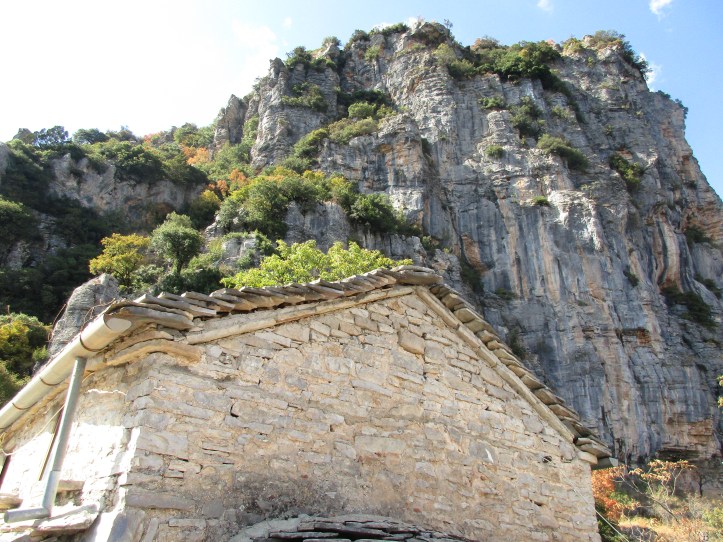
According to tradition, it was built around 1414 as an act of gratitude by Michail Therianos, Voivode of the area, for healing is daughter’s illnesses. The monastery’s frescoes date from the 16th-17th centuries. He and his wife and two children appear in Byzantine finery in the murals, if only I’d known to look for them!
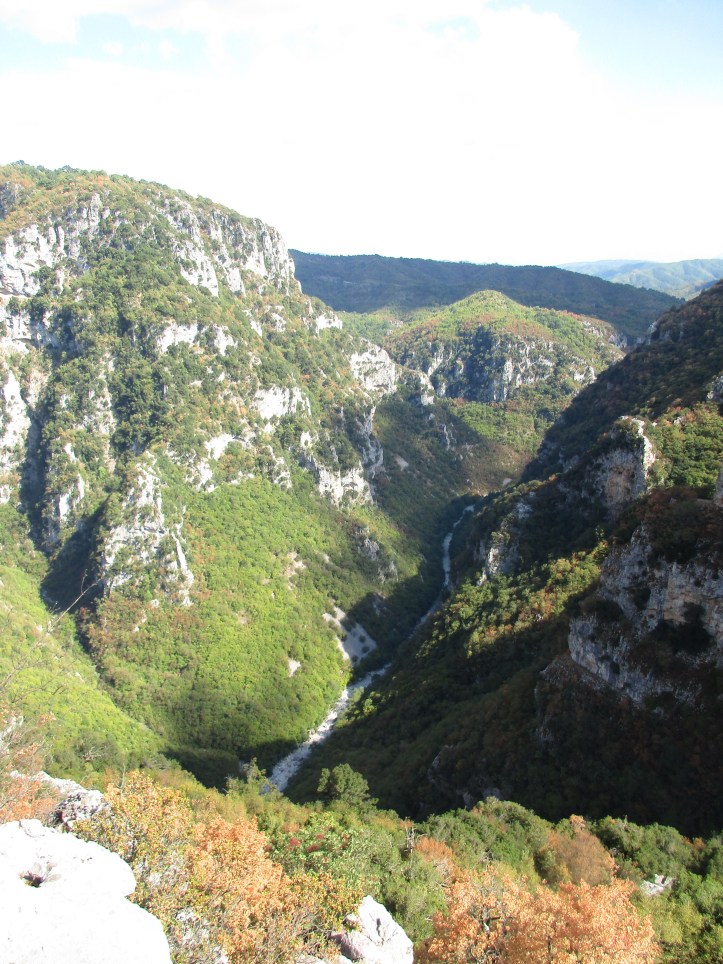
From a terrace opposite the entrance of the monastery we could clearly see the Vikos Gorge; according to the Guinness Book of Records, the deepest gorge relative to its width in the world. The Voidomatis River, said to be the cleanest river in Europe, has carved its path along the bottom of the gorge. The breathtaking gorge has many magnificent vertical geological formations with a wide variety of different ecosystems, as well as an abundance of flora and fauna which live in one of the most intriguing natural wildlife sanctuaries in Europe (https://www.desolationroad.gr/the-monastery-at-vikos-edge).
As our motorcoach descended the mountains, we stopped at one of the characteristic stone bridges for which the region is well known. Unfortunately, between taking photos with my phone and my digital cameras, those of the amazing bridge simply disappeared!
It was an amazing day of wonderful company, delicious Greek food, and built and natural sites to which I would really love to return – alone or with Constant Companion and Daughter.
 Creatively Annette
Annette. Thank you for your photos of Greece.
LikeLike