Constant Companion and I jumped the gun; we started our ArtAdventures early as you can read in the previous few posts. We were seeking both to get in as much as we could and more importantly save our stamina. Art saturation and just plain fatigue can set in quickly, more quickly because we’re not as young as we were when this all started more than twenty years ago.
If you’ve read my Art Week observations in previous years, you know that I’m drawn to textiles. I have frequently commented about artworks that manipulate and use textile techniques, fibers, and fabrics in different ways to create artworks. How people present themselves in their dress has been a topic frequently appearing in these posts. This year is not different.
An aside. My mother was a union seamstress and continued sewing much of her life. I was taught to sew and to knit. In college, textiles were a central part of my studies, maybe part of my DNA. It was not different this year.
So, I was particularly aware of the use of fabrics in a number of the artworks I was seeing. Another theme that stood out for me, was the restating of traditional culture. My academic background in folklore studies added to my long-standing interest in heritage and tradition.
It was the official Day One because many of the fairs opened Tuesday, albeit to the lofty VIPS. We chose to take it slowly and make it a two-fair day, with the Design Miami tent adjacent to the Convention Center and Art Basel itself and Untitled Art Fair, also located in a tent on the beach.
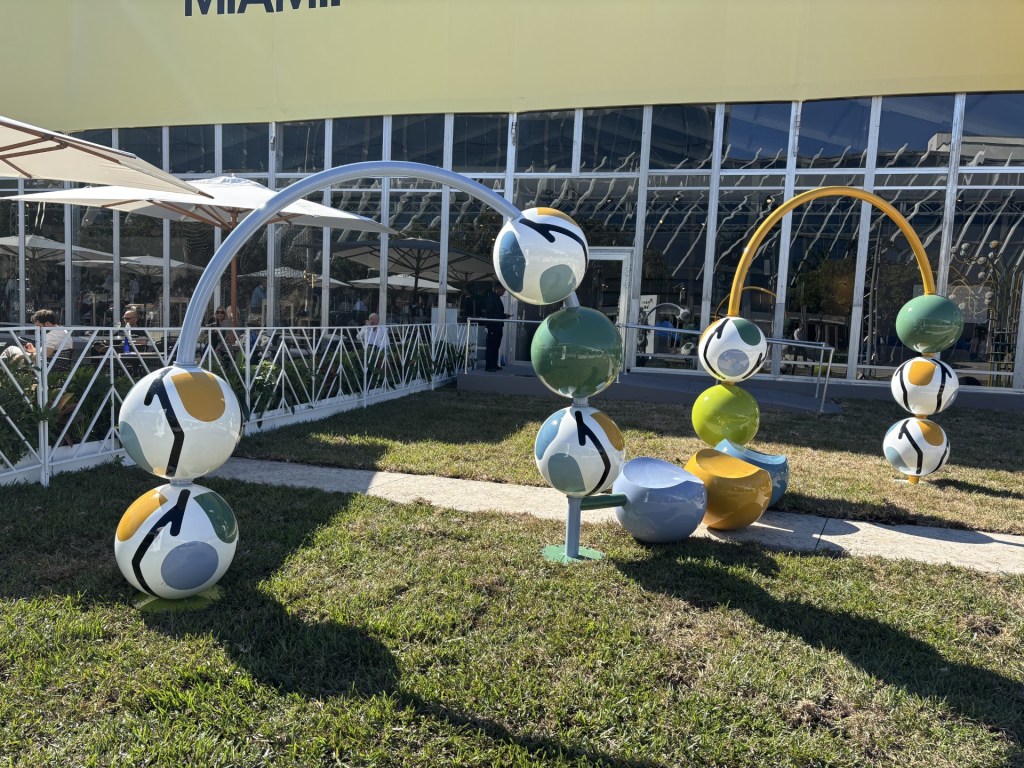
As in previous years, visitors to Design Miami are greeted by an extension of the annual design commission in the Design District across the Bay in Miami. This year contribution, “Pearl Jam” was created by Nicole Nomsa Moyo who was born in Zimbabwe, raised in South Africa, and is now based in Toronto. Giant beads pay to the intricate patterns and bold colors Southern African Ndebele women’s traditional arts. They resemble a necklace, a sprawling bracelet, and vibrant earrings. Tradition and modernity, as well as the unique heritage of these Southern African women unconsciously guided me to the pieces that I observed in both fairs.
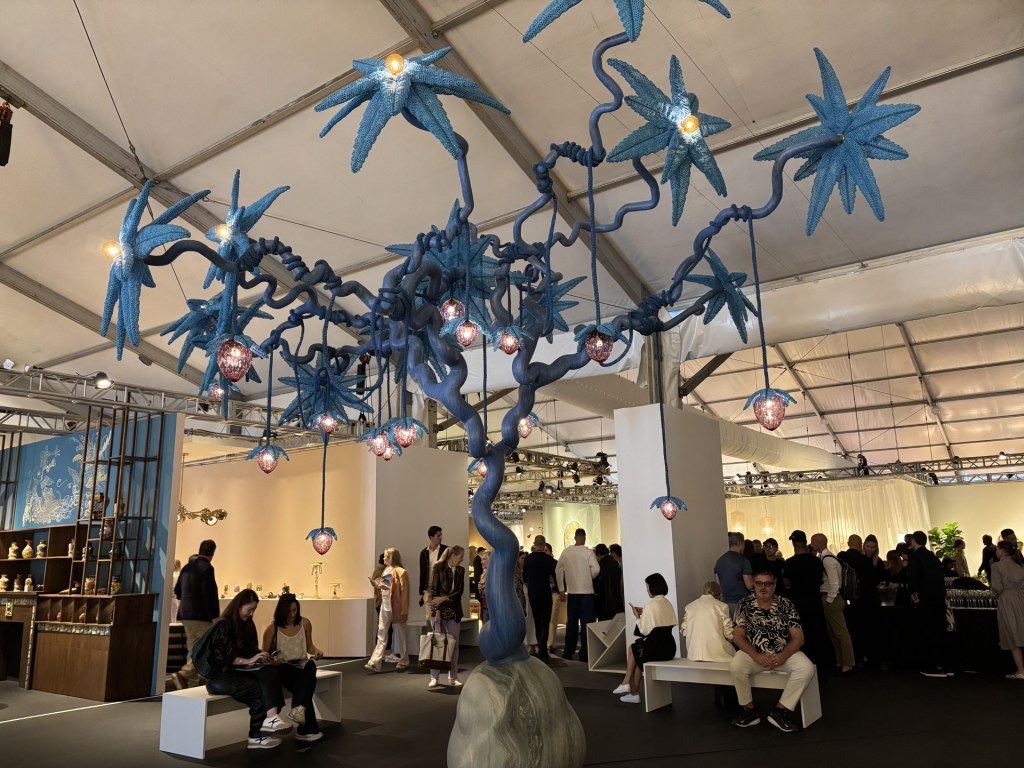
The floor of Design Miami was hopping. Lots of people enjoying lots of new, imaginative approaches to furniture, décor, jewelry, and other aspects of design. Lots of VIPs enjoying the Perrier-Jouët. I look forward to imaginatively engaging installations by Perrier-Jouët; this year there was none. On the other hand, the center of the fair was overshadowed by the Haas Brothers’ large-scale Strawberry Tree co-presented by R&R Company and Marianne Boesky. The structure is made up of leaves made of networks of thousands of vintage blue beads and over-sized pink luminescent glass strawberries.
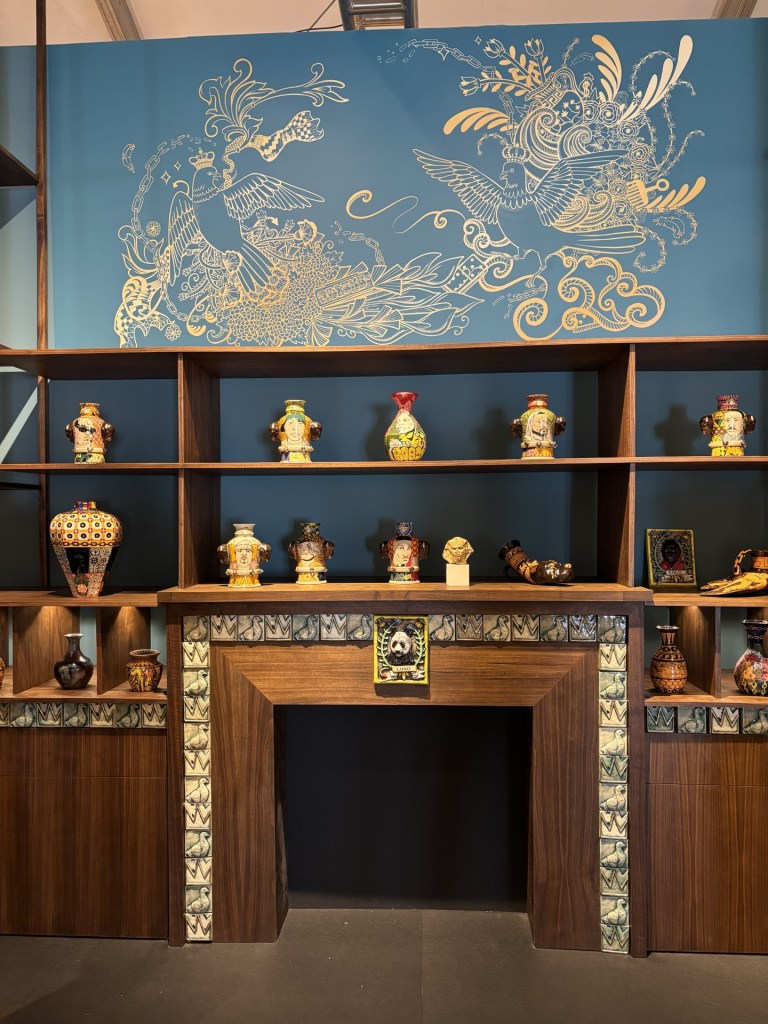
A display of the work of the Philadelphia-based ceramic artist, activist, educator, and spoken word poet Roberto Lugo was opposite the tree. Lugo, raised in New York City, honor his Puerto Rican heritage and culture and the people with whom he grew up. The bodega-inspired storefrong from R & R Company is called the Village Potter. They hope to show that art and design are for everyone.
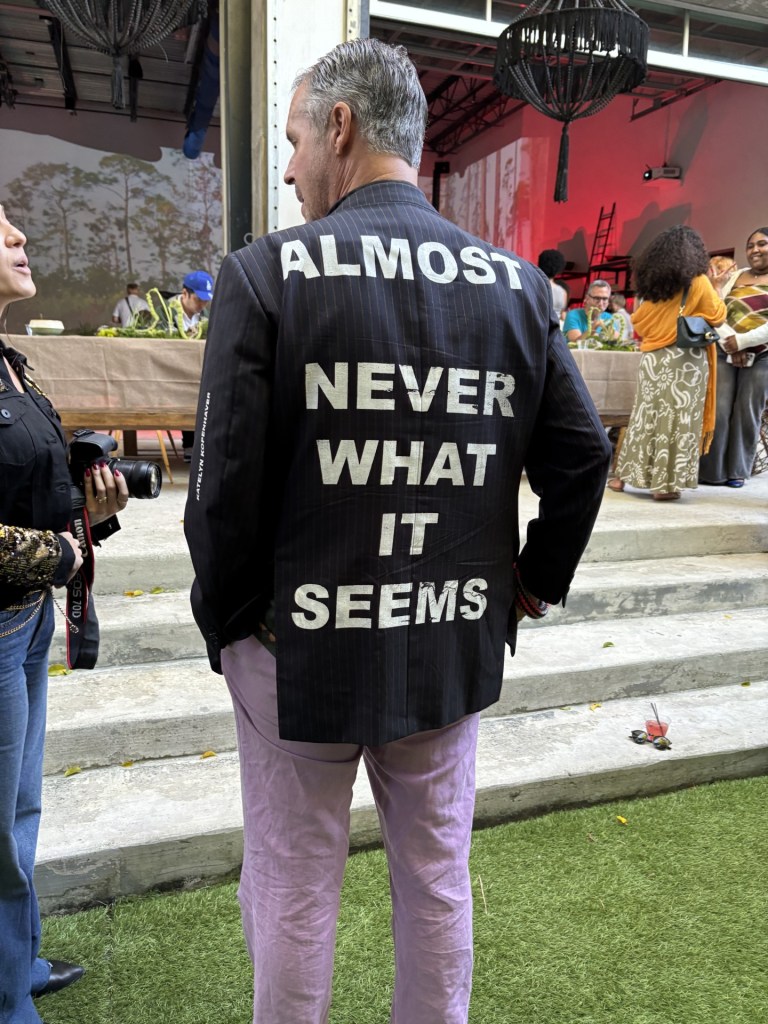
Clothing seen along the way. Sometimes I surreptitiously snap photos of fair-goers; other times, I ask. Those I ask are usually surprised, pleased, and a bit delighted to have some attention. The other day I saw this wonderful jacket by Katelyn Kopenhaver, local interdisciplinary artist. She vividly used words to draw attention to inequities and more.

At Design Miami, I caught this folk-looking jacket, a product of Bode. This line specializes in one-of-a-kind garments made from historical and domestic textiles.

This lady at Design Miami proudly wore a fashion-center outfit of ikat-dyed silk, traditional from Uzbekistan.
Textiles. When Constant Companion and I started our stroll through Design Miami, Guidette Carbonell’s whimsically delightful birds were the first items to draw me in. Carbonell’s father was Catalan, her mother Armenian. In some of her work both Catalan and Armenian folklores inspired some of her dreamlike work with of the aesthetics of fairy tales and fantasy.
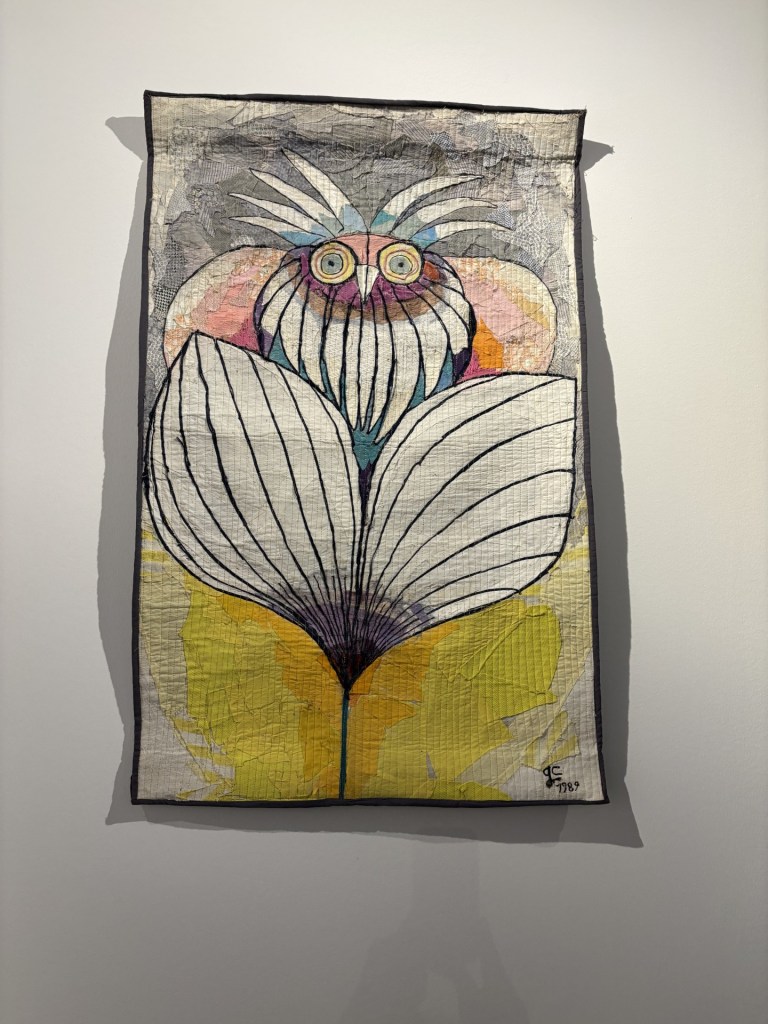
Carbonell collected and assembled bits of fabric into mélanges to create her enigmatic birds.

The metal, suspended mobiles of American master, Alexander Calder, are found in the art fairs every year. This display Calder tapestry represents the same visual design and sensibilities as well as movement in another medium.
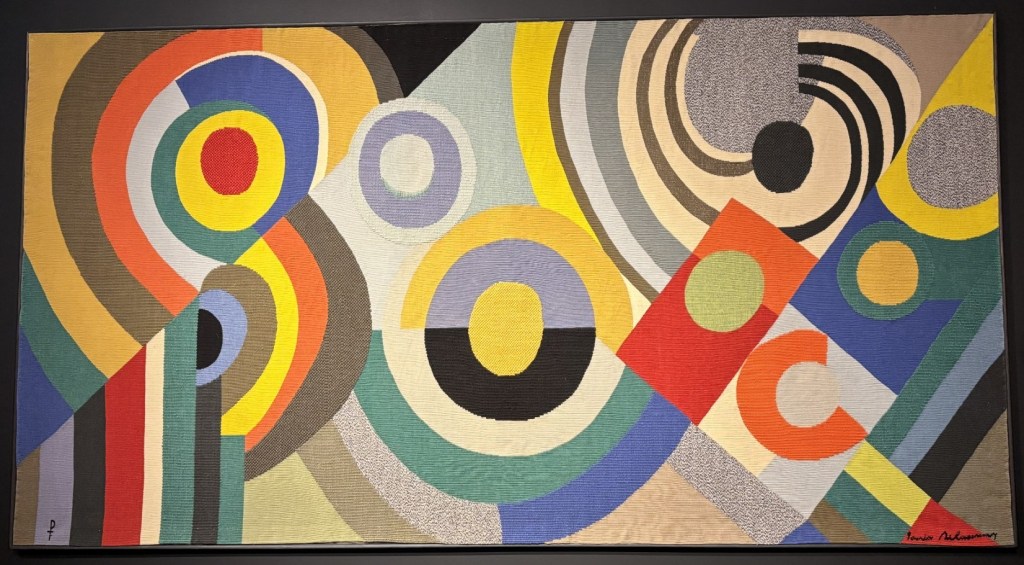
On the other hand, alongside Calder’s works, I noticed this carpet. I recently read about an early 20th century abstract art movement called Orphism in Artsy. Here it is in living fiber colors!
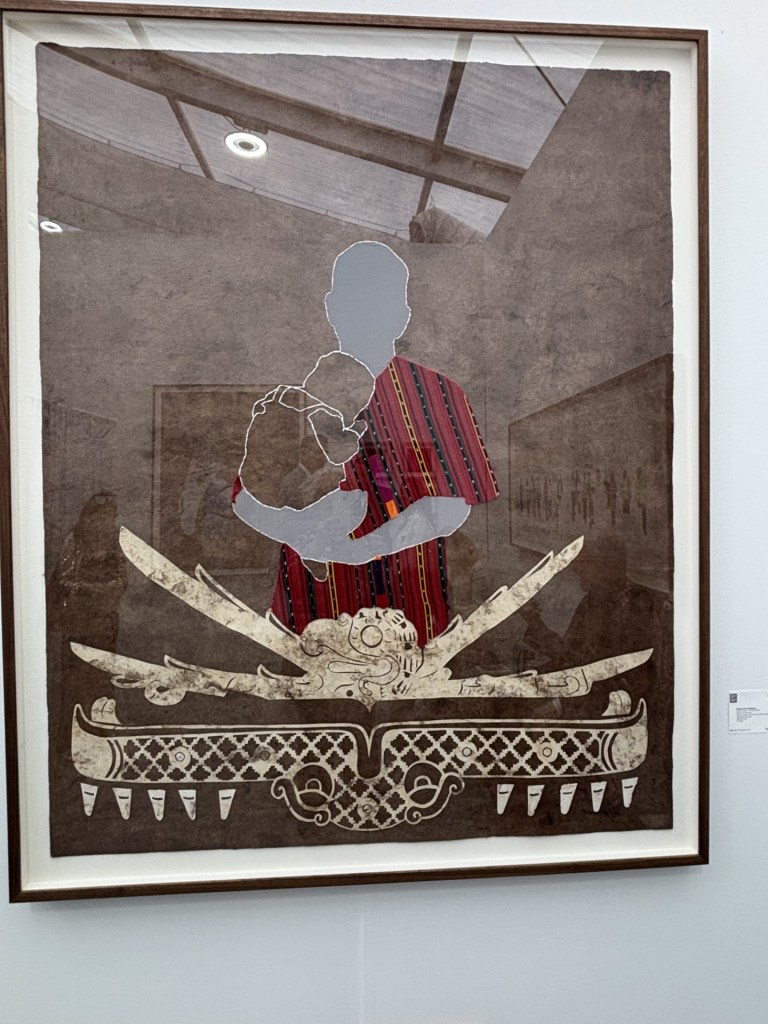
Next stop was Untitled Miami, which launched in 2012. And back to my theme of tradition. the works of several artists stood out. First was Arleene Correa Valencia is a Mexican-American artist based in San Francisco. The works she showed skillfully incorporated textiles with amate paper* made by Jose Daniel Santos De La Puerta to address issues of identity and migration.
* Many of us who have had a Mexican vacation have probably bought small tourist artworks on the dark brown amate paper.
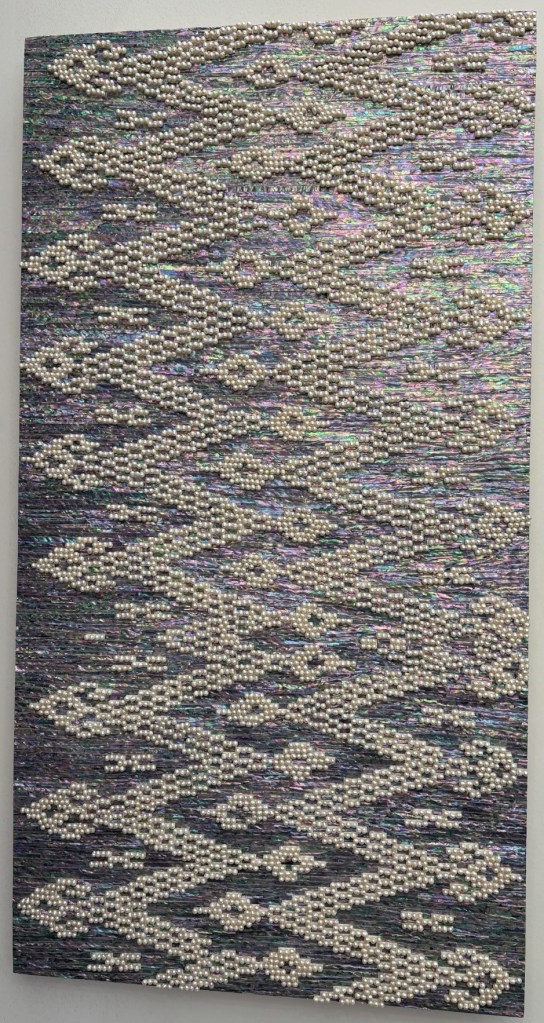
Charlene Tan, a Filipina-Chinese-American identity, draws from her her artistic cultural heritage of tribal weaving patterns of the Philippines. Her work focuses on the immigrant diaspora and identity. She uses trade Filipino goods such as pearls, mother of pearl, mung beans to meticulously construct her tapestries that reference traditional tribal weavings and tattoos.
Art works in two different galleries reminded me of Moroccan traditional crafts and my university days when I spent two memorable weeks in Morocco conducting an informal study of textile traditions. While in Fez, I spent several days in a government supported weaving school where young women learned to make carpets. The thick piled framed carpet segments by Amina Agueznay brought back that memory from the past.

The intricate woodwork of Brazilian conceptual artist Rommulo Vieira Conceição reminded me of the complexities of mujedar architecture of the 12th to 17th century Iberian Peninsula
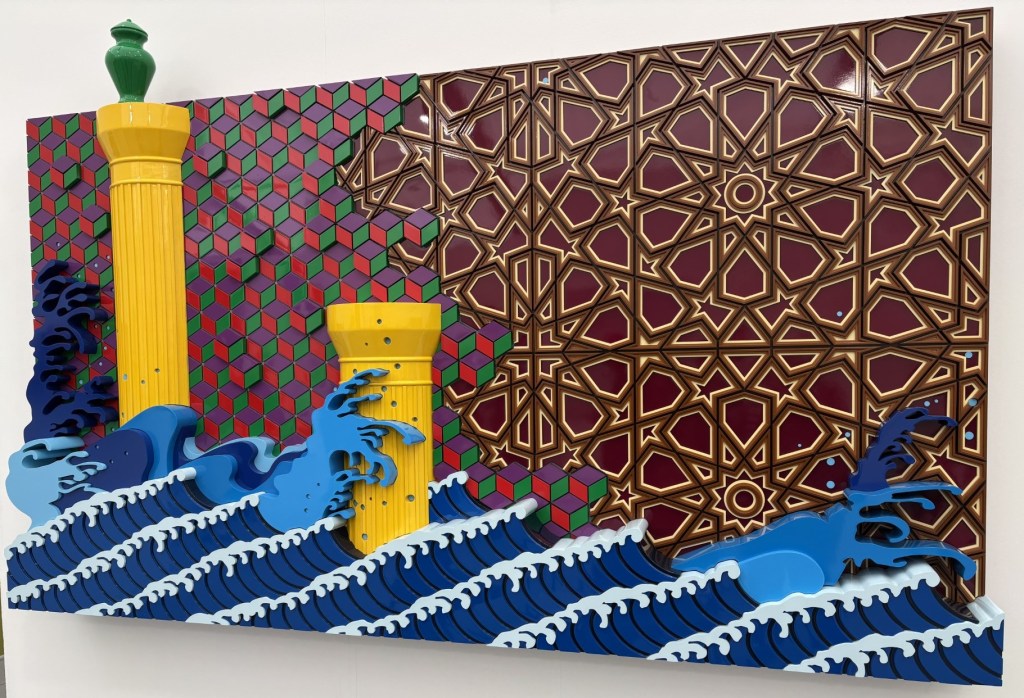
There was so much more at both fairs, as can be imagined. Both of us looked forward to more art-filled days … adventures.
 Creatively Annette
Thank you!
LikeLike
How about the orphism! Too cool.
LikeLike